
Making Significant Decisions (Acts 15:1-36)
- The Jerusalem Council -
Paul J. Bucknell
Guidelines for Church Councils
Acts 15:13-21
Purpose: Acts 15's discussion on the Jerusalem Church Council provides guiding principles for church councils as well as conclusions on how to respond to wayward church councils. A chart of major church councils is provided. This page also summarizes teachings from Acts 15:13-21 (Part 6 of 7).
Decisions Acts 15:1-36 | Make Acts 15:1-5 | Discuss Acts 15:6-12 |
Scripture Acts 15:13-18 | Decision 15:19-21 | Council Acts 15:13-21 | Communicate Acts 15:22-36 | Acts 15 Video Making Significant Decisions
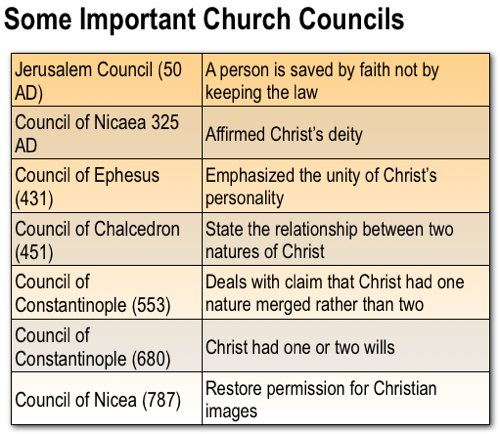
(The chart of church councils is adapted from Earle Cairns, Christianity Through the Centuries, p. 142.)
-
Church councils are not always right.
The Council of Trent (1500s) actually countered the decision of the Jerusalem council. In this case the church or professing church countered the clear council of the Jerusalem council. We need to emphasize what the scripture states as important.
-
Councils should keep to the scriptures.
Sometimes far too much time is spent trying to resolve ‘unresolvable’ matters such as whether Christ’s nature was merged into one or joined together as two.
I personally resolve this by disciplining myself to think about and to emphasize what the scriptures emphasizes. If it is revealed and clarified in the scriptures, then it is important to our lives.We should understand these things. If it is not revealed in the scriptures, then I am not to spend much time speculating on these matters.
We can speculate about many matters, but it does not mean that it is profitable to do this. Salvation by grace through faith is an important issue discussed here in the Council of Jerusalem and elsewhere in the scriptures. Whether Christ has two wills or how his divine and human nature are merged is not something we should spend much time discussing. The scriptures do not spend time discussing the details on how Christ's nature merges together. The scriptures do speak about Christ's deity and humanhood but largely from the perspective provided in Philippians 2:3-11. This point of oneness is worth emphasizing but not on how His two natures precisely work together or whether this would make Him have one or two wills.
-
Councils should avoid political governent interference.
Another problem with the ecumenical councils were the political involvement in the decisions such as when Constantine insisted on overseeing the Nicaea Council. This set a poor pattern where the emperor or other political leaders would influence decisions.
-
Councils should include church leaders (vocational and non-vocational).
Note the way the elders, God-led experience, scripture along with church leaders work together seeking what God wants. So often we have our agenda. Sometimes we spend far too much time thinking about ‘unresolvable’ matters such as whether Christ’s nature was merged into one or joined together as two.
-
What happens if chuch councils make poor decisions?
We note that many denominations will meet together and make horrible decisions. Should we just submit to them? No.They are no longer leading us in the truth. Through their decisions they have testified that they are not men of truth nor do they love God’s Word. They should properly be excommunicated but since they have power within the religious organization, they as enemies of the gospel remain within.
Conclusion on Acts 15:1-21
People often swing from the side of theology to the side of testimony or personal experience. It was nice to see the blend of experience and scripture here in this difficult issue. Experience alone should not dictate our thoughts but it is significant especially if it is affirmed by objective circumstances (in contrast to a personal dream). Experience, however, no matter how strong it seems, needs to be confirmed by the scriptures. The Pharisees had the scriptures and their personal experience but had a great difficulty opening up to this new way God was working even though it was right before their eyes.
Faith versus works is an important theological discussion. People on the whole look to gain their approval from God. The Gospel is contrary to this. It is by grace. This argument can be used whenever speaking to the religious or moralist. However, many people are no longer there in their thinking. They are not conscious of any real sin. In this case, we need to share about God’s expectations and then lead them to grace in Christ.
Summary discussion points on larger section Acts 15:1-21
-
Genuinely listen to one another
-
Believe in absolute truth
-
Stand up for truth (debate okay)
-
Value God-led experience
-
Use scripture for final judgment
-
Submit to the scriptures
Next -> B. Communicating Important Decisions (Acts 15:22-36) gives us insight to the important aspect of communciating decisions – a common problem in marriages, friendships and businesses.
BFF -> Moving our generation's heart and mind closer to the Lord through the powerful truths of God!