
Check out these BFF articles!

Catching the Excitement of Personal Devotions & Quiet Times
Spirit-Dependent Living
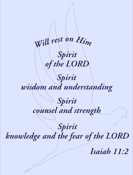
Isaiah 11:1-5
Waiting for Ministry
(1 Samuel 16)

All BFF's Biblical material in one spot! pdfs, powerpoints, podcasts, more!
Isaiah Studies
Isaiah 6:1-12 Four Steps to Righteous Living
How do we live righteous lives?
Examine Isaiah's calling to see the pattern of following the Lord.
Isaiah 9:6-7 The Government and Names of Yahweh
Each name reveals the glorious way the Lord rules His kingdom.
Isaiah 11:1-5 Spirit Dependent Living
Isaiah 11:1-5 shares the three keys needed in drawing close to God. Seven special 'Spirit' qualities are shared with practical insights. (Study Questions included)
Isaiah 11:6-16 Christ's Rule
Isaiah 11:6-16 is suppose to give us faith today! Learn five arguments why the 'wolf will lie down with the lamb' is for today. (Study Questions included)
Isaiah 29-32 Waiting and Planning
Eight principles on how to make good plans that resolve the tension between self-reliance and trusting God. (Study Questions included)
Isaiah 38 Steps to Waiting upon God
Three key principles are found in this passage to shape our own decision making process during crisis times. (Study Questions included)
Isaiah 40:1-5 Understanding Discipleship
Feel frustrated with your Christian growth? At a plateau? Learn the key ways the Lord builds effective disciples! (Study Questions included)
Isaiah 50:4-5 The Heart of True Discipleship
Be introduced to discipleship here! Included in this study is the training, purpose, disciplines and needed attentiveness of the disciple.
Isaiah 53 (52:13-53:12) The Making of a Godly Leader
Isaiah 60:1-5 A Shining Light
How do we allow God's light to shine in us so that we become effective lights in this dark world? What does it mean to be light? (Study Questions included)
Isaiah 66:18-22 Declare His Glory Among the Nations
God has a mission which He is going to fulfill. God is determined (18), able (19) and has a plan (20-22). The more we align our lives with Him, the more our lives are fulfilled. (Study Questions included)
Christ's RuleIsaiah 11:6-16
|
Isaiah 11:6-16 Three Interpretations
Argument #1 Word context | #2 Logical presentation
#3 Last section's timing | #4 'My holy mountain' | #5 'In that day'
Isaiah 11:6-16 Bible study questions
Isaiah Outline | Timeline | Overview | Brief Introductions
Isaiah 1-6 | 7-12 | 13-23 | 24-27 | 28-33 | 34-35 | 36-39 | 40-66
Christ's Rule: Isaiah 11:6-16
Purpose
Christ’s powerful rule is an outgrowth of His ministry (11:1-5), described in Isaiah 11:6-16. The five provided arguments prove that verses 1-16 are one unit and, therefore, require a figurative interpretation. We limit our study to verses 6-16.
Introduction to Isaiah 11:6-16
Observations provide potent insights into a scripture passage, in this case, helping us appreciate our God-given ministry. Many interpreters have shifted the interpretation of Isaiah 11:6-9 to the distant future, which loses crucial faith-building exhortations. We believe verses 6-9 refer to the New Testament (NT) era and describe how His Spirit-filled people will increasingly impact the earth before Jesus Christ returns. This passage increases our faith in carrying out a ministry like Christ!
Below we will not only see how this passage refers to the New Testament (NT) era but also how His people are to have an increasing impact on the earth as His Spirit-filled people before Jesus Christ returns.
Text: Isaiah 11:6-16
(6) And the wolf will dwell with the lamb, And the leopard will lie down with the kid, And the calf and the young lion and the fatling together; And a little boy will lead them.
(7) Also the cow and the bear will graze; Their young will lie down together; And the lion will eat straw like the ox.
(8) And the nursing child will play by the hole of the cobra, And the weaned child will put his hand on the viper’s den.
 (9) They will not hurt or destroy in all My holy mountain, For the earth will be full of the knowledge of the LORD As the waters cover the sea. (Isaiah 11:6-9, NASB).
(10) Then it will come about in that day That the nations will resort to the root of Jesse, Who will stand as a signal for the peoples; And His resting place will be glorious.
(11) Then it will happen on that day that the Lord Will again recover the second time with His hand The remnant of His people, who will remain, From Assyria, Egypt, Pathros, Cush, Elam, Shinar, Hamath, And from the islands of the sea.
(12) And He will lift up a standard for the nations, And will assemble the banished ones of Israel, And will gather the dispersed of Judah From the four corners of the earth.
(13) Then the jealousy of Ephraim will depart, And those who harass Judah will be cut off; Ephraim will not be jealous of Judah, And Judah will not harass Ephraim.
(14) And they will swoop down on the slopes of the Philistines on the west; Together they will plunder the sons of the east; They will possess Edom and Moab; And the sons of Ammon will be subject to them.
(15) And the LORD will utterly destroy The tongue of the Sea of Egypt; And He will wave His hand over the River With His scorching wind; And He will strike it into seven streams, And make men walk over dry-shod.
(16) And there will be a highway from Assyria For the remnant of His people who will be left, Just as there was for Israel In the day that they came up out of the land of Egypt. (Isaiah 11:10-16, NASB).
Purpose of Isaiah 11:6-16
Isaiah 11:6-16 alerts God’s people to our great hope in Christ’s work through the Holy Spirit, as stated in the previous five verses (1-5). Christ mightily extends His gracious power and reach of God’s kingdom to the many broken and needy people through His people (Mat 5:3-4)..
Prayer
Dear Father in Heaven, forgive me for joining many others in misusing Your mighty Word. By placing it in the remote future, I have lived without it, empowering me today. I have been unable to have the power of God's Word mightily work in those around me. Christ was anointed. You showed us all how You desire to do it in Acts, but it is easier to think this passage doesn't apply today. Forgive me as your steward for hiding your talent in the ground without effectively using it for your glory and the benefit of others. In Christ's glorious Name, we pray, Amen.
Discussion of Proper Interpretation
The meaning of Isaiah 11:6-16 deepens our understanding of our gifts and calling. There are two ways we can interpret this passage. We can use a futuristic interpretation and treat these verses as irrelevant to us or see them as fulfilled, at least in part, due to Christ’s ministry. The verses will strengthen our faith and work to share Christ’s grace with those around us.
The truth is not hidden away as if we can't find it. We are to discover the truth of this passage and then apply these truths to our present ministries.
Which interpretation is correct? Some believe that Isaiah 11:1-5 should be separated from 6-16, or at least 6-9. While this passage is difficult to interpret, careful analysis helps us understand Isaiah’s message.
Verses 10-16 do not seem to be the main interpretative issue, as several New Testament references openly state that the kingdom of God is, in some form, presently on earth. For instance, Jesus is referred to as the “root of Jesse” from Isaiah 11:10, as are verses 1-5.
The critical problem arises from the symbolism in verses 6-9, where an unusual pairing of animals requires for some a yet future setting, maybe the millennium or of the new heavens and earth. Admittedly, it’s easy to accept these verses as prophetic, with future relevance, because we do not yet see a transformed creation where wolves can dwell with lambs, leopards with baby goats, or calves with a young lion. Zoo cages demonstrate that these animals don’t get along.
Although this interpretation might seem acceptable on the surface, it misses its inherent message and the promises under the New Covenant. A careful study helps us overcome our initial hindrances by proving that this whole chapter is one unit, not two or three arbitrarily pieced-together groups of verses.
This passage has at least three interpretations: literal, spiritualistic, and figurative, but we could add another, a blend of two. Each interpretation has its pros and cons. (1)
-
The literal interpretation demands a futuristic application to some millennium or eternal state. This interpretation faces several difficulties, the most significant being the context.
-
The spiritual or allegorical interpretation assigns hidden meanings to the items mentioned in 6-9. This interpretation requires general support for a figurative interpretation, but the numerous categories and contexts confound this approach.
-
We favor the figurative interpretation, which takes this whole chapter to be descriptive of the work of the Spirit in the church age associated with Christ Jesus’ first coming (1-5).
Many modern Christians favor the literal viewpoint because assigning unfamiliar scenes with a distant future that matches their particular doctrinal conclusions is easy. For this reason, we will articulate five significant reasons or arguments that the symbolic interpretation should be accepted.
Next => Arguments of Interpreting Isaiah 11:6-16
Notes
(1) Oswalt, in THE BOOK OF ISAIAH 1-39 (New International Commentary series) p. 283 for further discussion. "The first is literalistic, looking for a literal fulfilment of the words... A second means of interpretation is spiritualistic. The animals represent various spiritual conditions and states within human beings (cf. Calvin). ... The third way of interpreting this passage, and others like it, is the figurative. In this approach one concludes that an extended figure of speech is being used to make a single, comprehensive point, namely, that in the Messiah's reign the fears associated with insecurity, danger, and evil will be removed, not only for the individual but for the world as well (Rom. 8:19-21)."