IntroThe Lord has a loving plan for each one of us, but this plan or project is not what we usually think of. One might think of a big construction site rather than a sofa with nice pillows. God shapes His people through His Word and circumstances so to create a place for His glory. He indeed does forgive us of our sins, but He is insistent on cleaning our hearts of those sins, whether it be a big mountain or a deep steep valley. God is clearing a way through repentance. God has something much greater to place in our hearts! Text: Isaiah 40:1-5Comfort, O comfort My people, says your God. Speak kindly to Jerusalem; And call out to her, that her warfare has ended, That her iniquity has been removed, That she has received of the LORDS hand Double for all her sins. A voice is calling, Clear the way for the LORD in the wilderness; Make smooth in the desert a highway for our God. Let every valley be lifted up, And every mountain and hill be made low; And let the rough ground become a plain, And the rugged terrain a broad valley; Then the glory of the LORD will be revealed, And all flesh will see it together; For the mouth of the LORD has spoken. (Isaiah 40:1-5, NASB). PurposeTo help us understand the way God disciples His people that we might work along with Him and make more loyal disciples and effective servants. Prayer
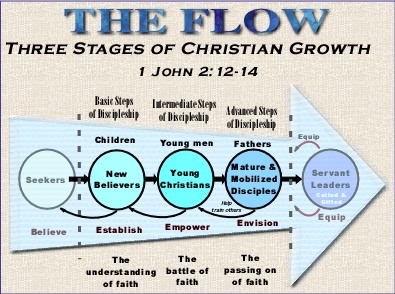
DiscussionThe LORD in Isaiah 40:1-5 highlights the overall means by which He redeems and uses His people. These three stages perfectly correspond with the three New Testament teachings of Christian living. The Lord justifies, sanctifies and glorifies His people. These three points, then, form an overall view of the journey of discipleship that our LORD takes His people on. We will first look at the summary chart and then a more fuller description below.
A. True Comfort (Isaiah 4O:1-2)
True comfort comes from the Lord when His people know that God's judgment has been effectively turned from them. Once His judgment is removed, we then need to learn and remember the great teachings of assurance of salvation, perseverance of the saints, God's everlasting love, election, holiness and adoption into His family. God declares us righteous through Christ's work on the cross. God has prepared the work necessary for reconciliation. Our faith in Christ and His work effectively applies it. This is what justification by faith means. When we have become God's children, we see that the judgment has been fully placed on Christ thus setting us free to thrive within a wonderful relationship with the Lord. Isaiah 40:1-2 refers to God's judgment upon His people for their wrong doing. This is a form of His discipline in which He uses difficult circumstances to bring His people back to Himself. This is true with God's covenant in the New Testament too. Without being part of His covenant, there is not discipline. There is no comfort. People just listlessly go along in the world until a final judgment. Application: A clear understanding of salvation is important or we will waver back and forth under the subjectivity of our feelings our whole lives. When we can interpret our lives from the perspective of God's Word, we then can rightly understand the work of sanctification and glorification in our lives. B. An Empty Room (Isaiah 40:3-4)
The goal is always the same: "Clear the way for the LORD." Jehovah Himself desires to live out His glorious self in our lives. The goal is not to just fill in the valleys and tear down the hills. The long term construction equipment and mess from this work might make us feel this, but it is not. Our lives are being transformed for the purpose of making room for the Lord. In essence then, this step can be summarized by a reshaping of our lives. God works on two major projects as noted below. After this, there is always a long series of minor work characterized by the first two but on a much smaller scale. This work is never comfortable but always necessary. The goal for all projects will be to let God live out His glory in our lives.
Before this work is discussed in more detail, we need to understand that we are not spiritualizing these words. Instead we are applying these words to clear New Testament instructions. This theme is more pronounced than most of us realize. John the Baptist clearly was the voice crying out in the wilderness (Isaiah 40:3). Jesus Christ was the glory of God that was proclaimed. Jesus "manifested His glory, and His disciples believed in Him." (John 2:11). The importance and priority of this work is seen in how Isaiah 40:3 is quoted in each Gospel.
This prophecy was fulfilled by Christ's coming. God's glory was fully revealed in Christ (cf. John 1:14-18). It was fulfilled in the sense that John the Baptist preached repentance and forgiveness and the people found their ways to the waters of the Jordan seeking baptism. He knew he was not the Way. He only made a way for the Lord.
This goal has not changed. We are to make a way for Christ by preaching the gospel of the kingdom. We are first to be affected by repentance and then call others to be follow Christ. This is exactly what we see in the synoptic gospels. The preparation comes by rightly responding to God in our lives and then encouraging others to do so. Let's read the way the synoptic gospels summarize the Great Commission.
Like John we are to humble ourselves to God's standards, be baptized and preach the Gospel of repentance. The message of repentance must first affect our own lives. We have to be ready to admit where we have failed and turn to Christ for forgiveness and imitate His life. Remember that this humbling of heart is to be permanent. Many Christians think that it is but during the point one is saved. Maturity in Christ comes as we regularly and continually recognize our emptiness and making room for Christ to fill us all and all. John the Baptist preached repentance. This repentance speaks of sins that we need to turn away from. They all hold back God's glorious work in our lives. Forgiveness is available through Christ for all of these sins. There are two specific areas that God targets in a person's life that we must repent from. We might think of them as one time areas of construction, but it seems that God more regularly does bits at a time. Perhaps this has to do more with our ignorance or stubbornness than the preferable way of doing most of it at one time. These two areas are related around our faith or belief. This is the same word in the original Greek. Christ in us brings humbling or healing. Two ways to keep us for effective service. Faith or belief are key issues of discipleship that affect us life long. 1) Lifting up the valleys - Lack of Faith: Healing and Rebuilding of our TrustGod's work of healing precedes the work of humbling. Healing is needed for spiritual wounds that have their source in doubt. Trust or faith must be rebuilt. Many of course fail in this because they rebuild self-confidence rather than God-confidence. This is a curse of our modern educational instruction. WE teach everything but how to learn from God. That is ridiculed.
These are the people who have been abused, manipulated, lust-driven, oppressed, addicted or victimized. They have wounds that can lead to complete hopelessness and suicide. These people might have low self-esteem but it is better to say that they have no hope or faith in God. God brings comfort by lifting the valley. The first step though is repentance. We might feel terrible for these people but they have not put their trust in God. They have given up and evil spirits accompany their unbelief so they soul feels dark and empty. They are very prone to accusations that they are no good. The modern preacher wrongly suggests that he is good! The scriptures point to repenting from fears and doubts. It is at this point God does a special work of renewal. God fills in the valley. He rebuilds our hope not in ourselves but in Christ. This condition of low self-esteem is corrected on its own as people get God's perspective of their lives. The gospel is good news for these broken people. Once they can accept their fallenness, they can welcome the Lord into their lives to fill them with His own companionship, acceptance love and hope. The Gospel promises comfort, strength and hope for all our broken aspects of our sin. Summary: Doubt is the lack of confidence or faith in God. It breeds brokenness by having fears, lusts, desires, situations and people rule over their lives. By confessing their sin and repenting from obedience to these things, they can find forgiveness and freedom in Christ. 2) Removing the Mountains - Misdirected Faith: Humbling and Redirecting of our TrustThe second major construction work takes place when God takes down the mountains and hills in our lives. Where the first group had a major problem of doubt or lack of faith, these have problems with trust in the wrong thing. They have a misdirected faith. Indeed, we acknowledge that their 'faith' does keep them from the sins mentioned above, they are nevertheless horribly sinful and selfish. Confidence can be in a number of areas including religion, philosophy, experience or self. In every case pride is associated with this confidence. Their pride gives them the feeling that they are right and do not need to subject what they believe to cross examination. Pride blinds themselves to certain areas of life and therefore is the opposite to humbling. A humble person admits they were wrong and is very open to God's solution. Self-confidence is the sin of our modern society and is filled with fame, success, wealth building, degree getting, etc. Those who are famous are not necessarily sinful, but those that are continually drag people's adoration toward themselves and their accomplishments. The problem is not confidence but mid-directed confidence. God wants us to have confidence or faith in Him and His promises. Instead of thinking we can handle problems, we ought to trust God to work out solutions to our problems by simply obeying Him in everything.
The hill has to be flattened out because there is no room for the glory of God as long as man seeks honor for himself. Removing mountains is hard work. Did you every see those earth-moving tractors?! We have a hard time facing our mountains but when we realize that something greater is to come, we are willing to be broken. When we see that our pride has messed up our lives and the lives of others close to us, we seek His presence.
There is a third construction. It is not major but minor. However, this minor construction is ongoing. He doesn't speak of deep valleys or deep mountains but things that get in the way. They characterize problems and temptations that we will face all our lives. Examples including wasting time and money on self, willingness for interpersonal relationships to be troubled, and plain old laziness. God works on these areas too!
Summary: God will be disrupting the lives of His people until Christ returns. This is what He is doing. We need to understand what work He is doing in our lives so that we can work along with Him. Some people because they do not understand this, remain stubborn so their lives need to go through bigger and more troublesome construction. In all of this, we need to carefully distinguish the reason God is doing these things. God has a goal higher than making us feel troubled. This is discussed further in the third point. C. Smoothing the Road -Refining our Faith: The Lord's Glory (Isaiah 40:5)
So it is with God's construction in our lives. We find that the goal of forming a level road is important, but it is not the end goal. The larger end purpose is that the glory of God might be revealed. His revealed presence is what makes all the construction hassles, detours and waits worth it all. Many people have not at all thought about the purpose God has in mind for their lives. They are thinking what they want of their lives. What a shame they miss out on the fulfillment of their lives! Let's try to better understand this concept of God's glory in our lives from the New Testament.
Many other verses share with us the way the glory of God wishes to operate in our lives. He chooses to exert His glory in our humble and broken vessels. We must then come down from our neatly planned thrones. Allow God to build one that is great for Him. From what I understand, this means our original dreams and visions will need to die in the dirt of time before His more glorious plans can be built. His plans will come into being as we live in humble obedience before Him. In this way, He gets the glory. The more you humble yourselves, the more room you make for Him. If you want to keep pushing your way, your knowledge, your experience, your wealth, your abilities, then you will have yourself. Not much glory there. Man's glory is nothing (Isaiah 40:6-8). We are like a withering piece of grass there for a day. But if we can gain an eternal glory in these frail vessels, then we will be forever awed.
I have chosen to deny myself. I choose to work myself hard in denying myself and seeking God's presence in my life. I have no greater good to work for than to have God live in me. There are costs but by His abundant graciousness, I will bear them. But think a moment. If we can trade in that which has little or no value for that which is eternal and glorious, will you do it? When we fix these goals clear in our heart, God will work with us in yet a more special way. He is looking for that man to stand in the gap. He is looking for that man who will live uprightly. Will you be that man?
Comfort, O comfort My people, says your God. Speak kindly to Jerusalem; and call out to her, that her warfare has ended, that her iniquity has been removed, that she has received of the LORD'S hand double for all her sins. What words are Isaiah told to tell to His people? In what frame of heart is he to speak them? Three times the word 'that' or 'because' is used in Isaiah 40:2. These are the three reasons he is told to say what he is suppose to say. What are the three reasons for this promised comfort? Explain each of these three reasons. Remember that Isaiah is in true prophetic style stating that the words from Isaiah 39 will come true but as it happens, His people will realize it has a purpose and a time limit. In other words God is watching over them. Apply this to the discipline God conducts with His people in the New Testament. Give verses to support your view. Again apply this to the discipline given by a parent. Give verses to support your views. The word 'salvation' refers to both the time when we are rescued from the world into God's covenant people, but also as His people when we are rescued from difficult times we were facing. What is true in these verses? How does this relate to the way God deals with you? B. An Empty Room (Isaiah 40:3-4)
Who do you suppose it is calling out? What does the voice cry out? What is the purpose for all this major construction? In what ways does he make the way clear for the Lord? Where else is this mentioned in scripture? How does the above description describe these three major works? Can you think of any other way to describe them? If so, write them down and support them with scripture. What is true repentance? C. The Lord's Glory (Isaiah 40:5)
What happens as a result of clearing the way for the LORD? What will be revealed? What does this mean? Does God desire that His glory be shone? Do you think that the Lord will make sure this spiritual principles always works out? Can you trust Him during your broken times for a closer experience with Him? What is your purpose in life? How much do you want His glory in your life? What might He do through your life if His glory shines?
BFF Homepage | Top | Back | Isaiah Index
Biblical Foundations for Freedom
NASB used |
||||||||||||||||||||||||||||||||||||||