Lingering Shadows
Living in a World of gods
Paul J. Bucknell
Who or what causes the mysterious powers surrounding us and what implications does it have for our lives?
The Inspiration of Worship
A sense of worship differentiates people from animals and other existing creatures or things. A recognition that something possesses more majesty and power embeds all human hearts, shaping their hopes and fears regardless of their language, status, or location.
Worship becomes a way to create meaning and hope in a person’s life—if one can tap into its resources. The worshippers’ immediate objective is to satisfy and ward off any potential harm coming from this mysterious power. To be sure, many people do not consciously think about the act of worship itself, especially not in the context of the spiritual world. But through their priorities and actions, many are communicating their hope that an extra boost of energy or connection and understanding will provide the extra peace and protection they need.
Some Confusion
Although many Buddhists, Muslims, Hindus, and Christians fill this world, their understandings of their respected religions vary so much that they can appear to be entirely different religions that merely share some commonalities. One’s perception of a religion or deity is not necessarily what is considered normal, real, or even accurate. Vague understandings and ignorance blur our knowledge. The Apostle Paul noted one altar dedicated to the “Unknown God” in Athens (Acts 17:23), testifying to mankind’s fear that they were coupling to the wrong God, gods, or goddesses.
The English word “agnosticism” is derived from this Greek word for “unknown” (agnostos), which means literally “without knowledge.” Today, the phrase “cannot be known” implies a spirit of indifference. The original meaning “We don’t know” has somehow led to the modern “We cannot know.” The ancient altar dedicated to the “unknown god” asserts the importance of preparing for every possibility when it comes to higher powers; after all, we wouldn’t want to bring down curses on ourselves because we neglected the unknown god.
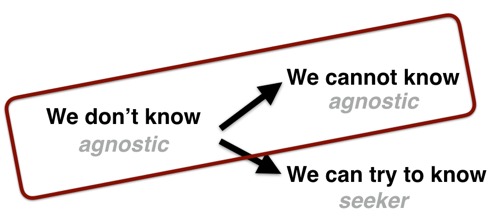
Today’s agnostic person will typically assume that there are no repercussions for ignoring what cannot be known. If the alternative were the case, they would become seekers. You know the phrase “What they don’t know can’t hurt them”? This is a dangerous and risky approach to God.
Others will admit that ignorance of the right supernatural power will cause them great harm or keep them from reaching their full potential. Some also believe that the spirits are somehow integrated with an animate object. Certain trees are in some places attached to mystical properties like the Asherim in the Bible. The Emperor of the Babylonians believed Daniel to have a “spirit of the holy gods” because he could interpret dreams.
A Bright Illustration
One great example to help us understand the plurality of gods greets us almost every night: the moon. The moon emanates a special glow on the earth’s dark places. Its mysterious and alluring shadows, along with its subdued light, draw our hearts and minds. The moon itself is worshiped by some, believing that there is a special power that can be gained through one’s devotion to it.
The great ancient city of Ur, from which Abraham came, was known for its worship of the moon, but this example is not exclusive; there exists a list of over ninety lunar deities. The moon’s power is subtle, intriguing, and engaging. We can understand why some people might think the moon is the source of extraordinary powers that are ready to be released to those who open their souls before it (him/her).
The moon, however, does not possess its own power; it is barren, dark, and cold. The moon gains all its light and brilliance from the sun, an outside source of light. In former days, there was no way to know this, but today, with the knowledge available to us growing exponentially, the moon’s power is revealed to be a fraud. The moon only possesses darkness.
The gods of this world work the same way as the moon. They, or the objects they are associated with, might have an element of allure, offering a power or attachment, in exchange for servitude. The power of the moon is nothing without the glory of the sun. Without the moon, we could perhaps still exist, but without the sun, there is not the slightest hope that life could exist on earth.
Lesser Things
Every day we gain energy from the sun directly and indirectly. The sun that God appointed to rule over the day warms us in this cold barren space and feeds the plants that we fully depend on for sustenance. Our fascination must not be with these lesser objects like the moon, for all derive their life from the sun.
Our inner desire to explore greater powers or to need them, is not wrong. The desire for greater things shows us that we need something more than biological fulfillment in order to properly function. We need something more to sate our spiritual and emotional needs. It is quite inadequate to look at the created world and expect to find the answers there.
Just as the moon is subject to the sun so the energy it reflects is not its own. When mankind turns to things, animate or inanimate, and places all hope and affection on them, it is a denial of the truth. To give adoration and attention to the moon for its light and changes becomes an insult to the sun, what actually provides that light and perception of change.
My point, however, is not on the moon or other celestial objects, fascinating though they are, but what they point to. God has formed the physical elements of the world to lead us to the truth about Himself as our Creator. “God made the two great lights, the greater light to govern the day, and the lesser light to govern the night; He made the stars also” (Genesis 1:16). The Infinite forms the finite, the Creator the created, the Unformed the formed (1 John 2:14).
Although it may appear right to revel in the sun’s powers, we would be acting in the darkness of foolishness. Even the sun depends on the One who made it. The sun’s energy is nothing compared to the Eternal Light. The apostle captured this thought well when he stated,
For even if there are so-called gods whether in heaven or on earth, as indeed there are many gods and many lords, yet for us there is but one God, the Father, from whom are all things, and we exist for Him; and one Lord, Jesus Christ, by whom are all things, and we exist through Him (1 Corinthians 8:5-6).
No matter what god, power, source, energy, light, warmth, strength, etc. that we might search for, they all derive their sustenance from God Himself. To put extra affection on these created things, seen or unseen, without a greater adoration swelling up in our hearts to God our Maker will cause us to act in an inferior way. The recognition of something greater, along with the discovery of our inner void should direct us to God alone. Otherwise, our actions become disingenuous, like praising the moon or sun, even though they gain their power from another, more powerful Source.
Two Examples
A few examples might help. Picture a salad. You might love all the various leafy greens, mixed with chopped greens and diced vegetables, covered with your favorite dressing, but all of this, and indeed all of our food, totally depends on the sun, which in turn is totally dependent upon God Himself. This is the reason people ought to turn their hearts to God and give thanks to Him for their food. Our thanks sanctify our food for our bodies by properly turning our appreciation from the delight of satiating our appetites to the One who loves to care for us.
Another example is found in rocks and gems. There are some who believe that powers, in differing degrees, emanate from various rocks. But even if there are powers, like those in herbs that contain healing power in their leaves, and though those powers are quieting or forceful, they all gain their energy from God Himself. When we gaze at a rock without remembering God who marvelously fashioned and hid the magnificent gems in the earth with their supposed powers, we ignore God’s genuine power and purpose. Even coal, though feared by some, is created with qualities that have thrusted our society forward into the industrial age. If we even look a little deeper, we would see how God, through the cosmic flood, created great gas fields around the globe by burying great forests deep within the earth.
Shy away from ignorance for it is bred in darkness and empowers the evil one. Note the following description of Lucifer before his beauty caused vanity to rise in his heart:
You were in Eden, the garden of God; Every precious stone was your covering: The ruby, the topaz, and the diamond; the beryl, the onyx, and the jasper; The lapis lazuli, the turquoise, and the emerald; and the gold, the workmanship of your settings and sockets, was in you. On the day that you were created, they were prepared (Ezekiel 28:13).
To understand ourselves apart from God’s design creates a chasm where darkness will hide, slowly disguising our true identities and destroying our ability to fulfill the purposes for our lives while on earth.
How interesting it is to see how God enhances the glory of leaves and rocks in the new creation, which only further magnifies His glory and enables us to enjoy His presence even more.And he showed me a river of the water of life, clear as crystal, coming from the throne of God and of the Lamb, in the middle of its street. And on either side of the river was the tree of life, bearing twelve kinds of fruit, yielding its fruit every month; and the leaves of the tree were for the healing of the nations (Revelations 22:1-2).
And the material of the wall was jasper; and the city was pure gold, like clear glass. The foundation stones of the city wall were adorned with every kind of precious stone. The first foundation stone was jasper; the second, sapphire; the third, chalcedony; the fourth, emerald; the fifth, sardonyx; the sixth, sardius; the seventh, chrysolite; the eighth, beryl; the ninth, topaz; the tenth, chrysoprase; the eleventh, jacinth; the twelfth, amethyst. And the twelve gates were twelve pearls; each one of the gates was a single pearl. And the street of the city was pure gold, like transparent glass (Revelations 21:18-21).
Created things like rocks, leaves, etc., are all holding back their full glorious purposes and beings, awaiting God’s full revelation of Jesus Christ and the new world.
For the anxious longing of the creation waits eagerly for the revealing of the sons of God. For the creation was subjected to futility, not of its own will, but because of Him who subjected it, in hope that the creation itself also will be set free from its slavery to corruption into the freedom of the glory of the children of God. For we know that the whole creation groans and suffers the pains of childbirth together until now. And not only this, but also we ourselves, having the first fruits of the Spirit, even we ourselves groan within ourselves, waiting eagerly for our adoption as sons, the redemption of our body (Romans 8:19-23).
The Final Picture
“God is light and in Him there is no darkness whatsoever” (1 John 1:6). God is the bright light, the superpower, the enriching warmth from which we, along with all inanimate objects, gain all that we are and need for our bodies, souls, and relationships. True enlightenment comes when we recognize God’s rightful place in this universe and worship Him alone. This is why God clearly stated in the Ten Commandments that we are to have no other gods before Him (Exodus 20:3) nor possess any idols (Exodus 20:3-4).
You shall have no other gods before Me. 4 You shall not make for yourself an idol, or any likeness of what is in heaven above or on the earth beneath or in the water under the earth. You shall not worship them or serve them; for I, the LORD your God, am a jealous God (Exodus 20:3-5).
Although various objects like the moon might have a subtle power and attraction, it really is only another call from God Himself to direct our full admiration and dependence on Him that we might alone give praise and thanks for providing for our needs, great and small. Although there are many unknown elements in the world, we have been cautioned against giving our attention to inferior objects, engaging though they may be, but our full adoration goes to God alone, who formed and sustained all created things through Jesus Christ.
And He (Jesus) is the image of the invisible God, the first-born of all creation. For by Him all things were created, both in the heavens and on earth, visible and invisible, whether thrones or dominions or rulers or authorities--all things have been created by Him and for Him. And He is before all things, and in Him all things hold together (Colossians 1:15-17).
Consider who or what you are fascinated by. It might be a person, an object, or the spirit behind some object. Now, take another step back and try to gain a greater understanding of the whole scene and realize how God’s greater being, through Jesus, is drawing us to Himself to worship. Put away all objects that confuse you with their supposed innate powers and glory in this world. God, Himself wants you to worship Him along with all your heart, soul, and mind! Only then can you rightly discern how to use the things that He has kindly given you.
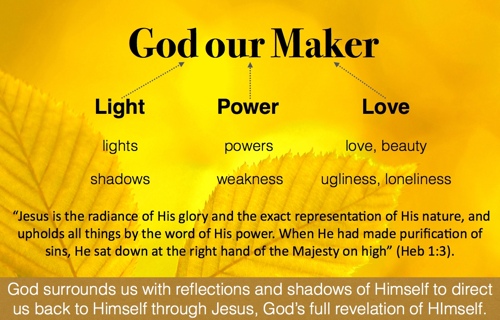
But how can we rightly approach the Living, Holy God? This is a worthy question to ask. Even as our God has provided special leaves, gems, and food for us, so He also gave us His only Son, Jesus Christ, to die that we can be forgiven. True life is found in Jesus; forgiveness leads to restoration with our Creator which, then, enables us to live in relationship with.
There are many powers lingering about us, but they all point us to the larger, hidden might of God. Likewise, we have many shadows and lights about us, but they equally point us back to the true Light, which again is God. Let us not be misled by idols, or indefinitely delayed by the worship of an ‘unknown’ god, no matter what essence of power or mystery it offers, but let us turn in full confession and devotion to God, who supplies all we need, especially the love of Jesus Christ, a love so deep that it penetrates our every vein of fear, weakness, and loneliness.
“Again, therefore, Jesus spoke to them, saying, ‘I am the light of the world; he who follows Me shall not walk in the darkness, but shall have the light of life’” (John 8:12).
“For with Thee is the fountain of life; In Thy light we see light” (Psalm 36:9).
“And this is the message we have heard from Him (Jesus) and announce to you, that God is light, and in Him, there is no darkness at all” (1 John 1:5).