Jesus’ Claim to Deity
John 5:18–23
We need to ask why Jesus shared such a private message about His innermost thoughts
(see verses 5:19–20)
with the public at hand. This becomes even more dramatic when we think of the
larger context of the Gospel of John.
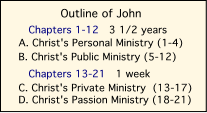
The Gospel of John’s first four chapters shows Jesus conversing with people on a personal level. It is here in chapter 5 that Jesus starts speaking to the public as a whole. He addresses large groups of people in numerous kinds of settings. The key to understanding John’s purpose is seen in the “therefore” of verse 19. Jesus was clarifying His own view about being called God in verse 18.
For this cause therefore the Jews were seeking all the more to kill Him, because He not only was breaking the Sabbath, but also was calling God His own Father, making Himself equal with God. (John 5:18).
 In the eyes of the Jews, they knew that when Jesus called God His own Father, He meant something more than the average Jew meant.
They were out to kill Him for blasphemy. Jehovah's Witnesses vehemently deny Jesus’ deity, but this passage clearly shows what they seek to disprove.
Jesus affirmed His deity in three ways.
In the eyes of the Jews, they knew that when Jesus called God His own Father, He meant something more than the average Jew meant.
They were out to kill Him for blasphemy. Jehovah's Witnesses vehemently deny Jesus’ deity, but this passage clearly shows what they seek to disprove.
Jesus affirmed His deity in three ways.
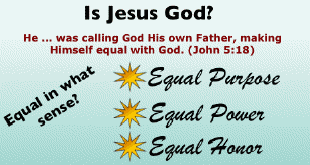
First, John showed that the Father and the Son have the same purpose. Second, he shows how they are of equal power. Lastly, John shows how Jesus said He had the same honor. Any of these points would affirm His deity. They claim just what was said of Christ in John 1:1–3.
#1 Same Purpose (John 5:19)
Who could claim that any of us has the same purpose as the Father? We would like to claim that, but we realize we would need to be God to do just as God wants. We would need the mind of God to do the will of God. John 1:1 says Jesus was with God. They were of common purpose. Verses 19–20 emphasize how the Father and the Son perfectly worked together. They are of one purpose. Jesus shares how this was possible.
When we apply this to ourselves, we know it means something similar—but not exactly the same. We do not have the mind of God in the same sense that Jesus did. We know that as we pray and seek God in His Word, the mind of Christ is made clear to us.
#2 Same Power (John 5:20–22)
He also shows how the Father and the Son are of equal power. Jesus gives life. He judges (5:21). These are prerogatives of God alone. And yet this is exactly what we find Jesus doing. Jehovah Witnesses tell us that Jesus did not claim to be God. Of course, if He directly claimed it, they would stone Him to death on the spot. As it was, His implicit claim to deity by having equal power already stirred them up enough to seek His death. Jesus instead allows the audience to draw the conclusion. Only Christ had God’s powers.
This, of course, affirmed His deity. When Christians do miracles, it is not by our own power. We heal “in the Name of Jesus.”
#3 Same Honor (John 5:23)
Jesus also had the same honor as the Father. A Christian is able to work with God in doing His work, but we never gain the same honor as God. We should never say or think, “I am so great. Look at what I did. I am God.” Jesus did this though. Listen to John’s words: “so that all may honor the Son, even as they honor the Father.” We know it is God’s work; we dare not take such honor to ourselves. We are just glad that we can serve the Father in Jesus’ mighty Name.
Jesus, however, actually claimed equal honor and glory with the Father. Our worship should be the same.
We understand the dilemma Jehovah Witnesses put themselves in when they outright deny the teachings of the Godhead or Trinity. They have absolutely no way to explain Christ’s affirmation of deity in these passages. They insist that because Jesus is a different person, He is only a god. The word “trinity” is not in the Bible, but the concept is alive and well—just as it is in John 1:1–3.
Summary
We find that Jesus here gave three clear affirmations of His deity. He didn’t tell the crowd not to assume His mention of God as His Father had to do with His having the same nature as God—and being God. Jesus did make Himself equal with God and clearly affirmed how He was equal with God the Father and worked alongside Him.
Only when it was time to die did Jesus affirm His deity in clear words when forced to by special inscription.
But He kept silent, and made no answer. Again the high priest was questioning Him, and saying to Him, “Are You the Christ, the Son of the Blessed One?” And Jesus said, “I am; and you shall see THE SON OF MAN SITTING AT THE RIGHT HAND OF POWER, and COMING WITH THE CLOUDS OF HEAVEN.” And tearing his clothes, the high priest said, “What further need do we have of witnesses? You have heard the blasphemy; how does it seem to you?” And they all condemned Him to be deserving of death. (Mark 14:61–64).
Again, the leaders’ response confirms the seriousness of Christ’s claim to deity.

We have a video on John 5:1–24, but it is part of our NT Biblical Library package. This Library has an incredible amount of training materials in PDF and PowerPoint format ready to print out and share. We even have videos and MP3s! We allow you to copy, modify, and distribute material for teaching or personal edification.