

 BFF is now on Facebook! Please visit and join us in releasing God's powerful Word to our generation!

God's peace can help us live above anxieties as we learn to trust in Him!



The Bible Teaching Commentary on Genesis: The Book of Foundations
Commentaries that specialize on training the teacher!


Train Leaders for Ministry
The process of caring for those who have committed themselves
to full-time service.
Rev. Paul J. Bucknell
Train up! | Support God's Work | Leader's Responsibility
Confirmation of the Call | Training Process | General Plan | Specific Plan
Too Many People | Summary
Purchase e-Book (pdf, epub, mobi)
The Specific Plan of Development
Purpose
The Specific Plan of Development is part seven of a series on Train Up New Leaders for Ministry which describes four specific areas of development one needs to fulfill to some degree before going into full-time ministry, especially the one going into missions work.
• The Leader's Responsibility
• The Specific Plan
 You might feel a bit more apprehensive about the specific steps of training, having such a busy schedule as you do. After reading this, we hope you will not feel so inadequate.
From Ephesians 4:11-13 we read of God’s gifted people in the church. They are to equip God’s people to serve. Sometimes, we conclude that only the pastor is to do all the work. The pastor, however, does not have all the gifts and wisdom to do the proper job. Nor does he have the time!
The Coordinator
First, you need to find someone who will coordinate the training. This person will see to it that the process continues on with periodic evaluation. During an initial evaluation, specific areas of need are discovered. The most significant ones should be mentioned. Others can be brought up with discretion. We do not want to overwhelm the individual.
After a special area of need is brought up or discovered, there needs to be plan of action. 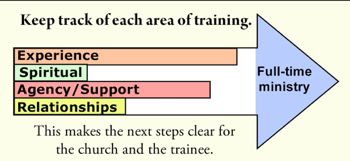 This person can be the pastor, elder, deacon or missions chairman. You might even have a furloughed or retired missionary at your church. They can help.
If your church is small, see if you can pool resources with a few other church. Just remember to go over the four points above so that you are thinking the same way.
Your goal is to see growth in each of the four areas. It would help to have the person under training to report to someone else in leadership to make sure the mentor relationship is going well.
The pastor should periodically review the folder with the person who is mentoring to keep connected. Remember that the end purpose of training a missionary is to send him out. The church needs to take proper steps to think how to support that person in each area of his life. If well supervised, these individuals can become a great asset to your church during this training.
One of the first things to do is to give a copy of ‘Take Your Next Step into Ministry’ to each person heading into full-time or tentmaking ministry. They are to read and study the article.
After going through the article with them, ask them to identify all the obstacles that they are facing before they can get to the mission field. This list should include uncooperative parents, a spouse with a different heart and loans. They also need to identify needed areas of training such as discipleship methods, overcoming temptation and character development.
After a general discussion with him over those two broad categories, you and he/she have a much better understanding of the needs that God wants attended to in this training period. You yourself will have your own observations, but start with their list.
Purchase e-Book (pdf, epub, mobi)
Guide your conversations
As you talk with him, you will be thinking through several issues:
-
What are his or her specific needs?
-
Where do we want to bring this person?
-
How long might it take to work through these issues?
-
Which areas are the most urgent?
-
Which areas of training can be done at the same time?
-
Who has experience in dealing with these areas of training?
-
Are there any good reference materials regarding these subjects?
Good coordination
The training process, though overseen by one person, can best be done by several people over a period of time. When we really do not have someone to train a person in a certain area, then we can find outside resources that will help.
For example, what do we do when we find that a person worries a lot? This worry interferes with his or her decision making process. God doesn’t want him to worry. To be effective in ministry he needs to overcome his worries.
This particular need should be marked down on the page addressing moral qualities. The overseer then needs to start looking for individuals who have overcome worry that can share with him. Or perhaps the pastor has a series of tapes on the topic.
If resources are not found in the church, then one can look for outside resources. There may be a conference that he can attend or study material on God’s way to overcome anxiety on the web.
-
Find areas of need.
-
Trust God for wisdom.
-
Design learning opportunities.
Keep them accountable.Please do not make the mistake of having them take a secular course! As a good shepherd you must make sure that changes in people occur by applying biblical principles.
It is imperative to keep that person accountable to applying and practicing those principles until they become his or hers. In other words, this person should not just attend a conference or read a book but meet God in such a way that he has learned to overcome those personal struggles.
A few more examples
If you find that the trainee is not regularly meeting with the Lord each day, then you need to train him how to have proper devotional times. Poor devotions reveal a lack of appreciation for the way God strengthen and leads His people.
If they don’t regularly come to prayer meeting, then someone needs to work with them on the importance of a strong prayer life. These are the foundations of Christian living and without faithful Christian living there is no effective Christian ministry.
What about skills? Has the person done visitation? Does he know how to lead people to the Lord? Who has he discipled? Does he know how to do these things? These are things that he should easily be able to learn in the church. Leading worship, teaching children, youth and adults, and preaching are other skills.
As a special need or opportunity of service comes up, you might need to find another mentor for the trainee in that area. Do not just assign him as the youth director but assign him as youth director with a mentor.
The mentor will focus on developing one specific area, but he also needs to be sensitive to other particular problems that the trainee might face. If a serious problem arises that requires another major area of training, then one should probably find another mentor to help. If that one mentor feels comfortable addressing that situation, a new progress report can be initiated in that particular area.
You will start looking at your members in a different way when you start overseeing someone’s training. Your congregation members will become resources to help others grow. You will also see specific areas in which they can by God’s grace grow. No one is perfect, and yet God has already grown the people in your congregation through many different life events.
These individuals might not be the person who will oversee the one in training, but many will have special insights and stories to contribute. You might encourage a couple to have dinner with the couple you are mentoring and have them share how they have come to have a good solid marriage. Just give inexperienced mentors specific assignments so they know what is expected of them. Be a mentor of mentors.
Please remember to keep the person accountable, not only of what they have learned about a certain issue, but how they are applying it to their lives. For example, if his parents are resolute against him going into full-time service, we need to carefully pray and monitor his relationship with his parents.
We should expect a change to occur in their hearts. This opposition could well be a sign from the Lord that this individual must improve on his relationships with his parents.
A Leader’s Project
Start talking to the people who went forward to commit his or her life to full-time participation in the Great Commission. Ask him or her to make two lists.
(1) They are to list all the obstacles hindering from being that person God has called him or her to be, and
(2) List the different areas of training that they need.
You might see other needs but start where they are. As you pray, think about individuals who can help in this process. Start off with one area and yet follow through and be consistent. Don’t try too much at once.
Next => Too many people!
Train Up New Leaders for Ministry
Purchase e-Book (pdf, epub, mobi)
Train up! | Support God's Work | Leader's Responsibility
Confirmation of the Call | Training Process | General Plan | Specific Plan
Too Many People | Summary

Take Your Next Step Into Ministry
Pursuit of Christ | Experience | Evaluation | Spiritual | Training | Relationships
BFF Homepage | Top | About us | Pray for us | BFF's Approach | BFF Store | BFF RSS | Topics | OT | NT
Biblical Foundations for Freedom ( BFF )
Rev. Paul J. Bucknell
info@foundationsforfreedom.net
Scriptures quoted from the New American Standard Bible unless noted
(C) Copyright The Lockman Foundation 1988