

 BFF is now on Facebook! Please visit and join us in releasing God's powerful Word to our generation!

God's peace can help us live above anxieties as we learn to trust in Him!



The Bible Teaching Commentary on Genesis: The Book of Foundations
Commentaries that specialize on training the teacher!


Take Your Next Step Into Ministry
Understanding God’s Training Program
for those in Ministry
Rev. Paul J. Bucknell
The Next Step | God's Goals | Starting Point | Learning from others
Pursuit of Christ | Experience | Evaluation | Spiritual | Training | Relationships
Pursuit of Christ | Experience | Evaluation | Spiritual | Training | Relationships
The Pursuit of Christ
Purpose
The Pursuit of Christ is part of the Take Your Next Step into Ministry series that helps a person interested in Christian full-time ministry and tentmaking to ask those crucial questions in order to properly prepare for full-time ministry.
God's Training Program Never Stops
Training for an effective full-time ministry never really stops. We constantly need to be readying our heart to rightly serve the Lord. We always have room to grow.
Order your download of Take Your Next Step here! pdf and ePub!
Jesus said, “You are to be perfect, as your heavenly Father is perfect” (Matthew 5:48).  We need, therefore, to attentively listen to the Lord for wisdom, courage, strength and endurance.
God’s training program might look a bit different after we have been serving the Lord for a while, but in many ways, what God has been doing will be the same thing He continues to do. God’s purifying goals for us demands a lifelong discipleship training. To be an effective leader we will need to be a faithful disciple.
Training is important for those in ministry. We might make a lot of difference between training before full-time ministry and afterwards, but the Lord doesn’t. We never graduate from His school of training until we reach heaven’s shores. He shapes us so that we can bear more fruit. It behooves us to better understand how He trains us.
King Saul resisted God’s training. He was qualified before man (tall, big and strong) but not before the Lord. God would have worked with him and did, but he persistently rejected God’s training for him. This attitude eventually stripped him of his opportunity to serve God and others.
Not Quite Ready!
In many cases a candidate for full-time ministry considers himself qualified for service before God does. This self-confidence probably comes from a mix of several problems: pride, misunderstanding of holiness and God and a calling from God. It is easy to equivocate a call from God as an appointment. A call should better be seen as a boost of confidence to direct in a certain path where we can serve Him more effectively in the future.
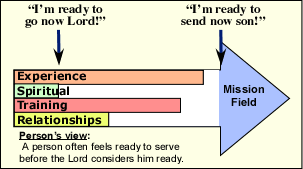 God, however, is the best appraiser of our strengths and weaknesses. There are numerous helps to evaluate a person’s qualifications for ministry but most of them fail. They are usually focused on graduation from a formal training program and the soundness of one’s doctrine. Though helpful, they often miserably fail all who only use these standards. This is due mostly to the deterioration of the family and the resulting lack of personal character.
Personal problems are compounded by the lack of ‘hands on’ training which is greatly enhanced by role models and personal challenges. God looked beyond David’s older and more mature brothers and chose the smallest boy out in the field shepherding because he had a heart after God.
We need to learn how to properly evaluate our qualifications for service. How do we do this? We must avoid the tendency to only look at what we know or have done. We need to focus on fruits from ministry, personal growth, and relationships within the church. Because of the emphasis on academic training, we tend to ask the wrong questions. Here are a few good and bad questions.
Bad and Good Questions
Bad: What do you know about God’s Word?
Good: How do you show your love for God’s Word?Bad: How do you feel about your past ministry?
What spiritual fruit have you seen in your spiritual service? Be specific.Bad: How long did you lead the youth group?
Good: Have you trained a new convert? How?Bad: How has your marriage been? How long have you been married?
Good: About how many times do you have friction with your spouse each week? From a scale of 1 to 10 (10=worse), rate those times.Bad: How long have you attended church there?
Good: Do you have tension with anyone in the church? If so, explain.
We need a better understanding of God’s full training program for our lives. Although we could focus on specific qualities needed for ministry, we will here take a more strategic approach.
Four Areas of Needed Training
Here are four special areas of training that the person who aspires to go into missions needs to pay close attention to. This does not differ too much for those going into the pastorate except in the area of raising support. Each will be quickly introduced here and expanded below.
Experience/training
Gain all the skills and knowledge one needs to enter full-time ministry.
Character/spiritual
Acquire and maintain the moral character and effective spiritual disciplines needed to nurture a close and intimate relationship with the Lord.
Mission/support
Make the proper contacts with a mission or denominational agency and raise the needed prayer, financial and other support.
Church relationships
Carry on good and proper relationships with those in one’s home church. Make sure clear communication is occurring.
If any area is neglected, then certain problems and misunderstandings will develop. There is no doubt that deficient areas will in time be exposed and cause damage in our ministries and lives.
God wants to properly prepare us so that He can more effectively work through our lives. He did not want Peter and the others to stumble. Neither does He want us to fail. Effective training leads to long-term success.
Next => Better understand the experience and skills for ministry
Take Your Next Step Into Ministry
Order your download of Take Your Next Step here! pdf and ePub!
_________________________
Pursuit of Christ | Experience | Evaluation | Spiritual | Training | Relationships
Training Up New Leaders for Full-time Ministry |
|


BFF Homepage | Top | About us | Pray for us | BFF's Approach | BFF Store | BFF RSS | Topics | OT | NT
Biblical Foundations for Freedom ( BFF )
Rev. Paul J. Bucknell
info@foundationsforfreedom.net
Scriptures quoted from the New American Standard Bible unless noted
(C) Copyright The Lockman Foundation 1988