
 BFF is now on Facebook! Please visit and join us in releasing God's powerful Word to our generation!
God's peace can help us live above anxieties as we learn to trust in Him!


The Bible Teaching Commentary on Genesis: The Book of Foundations
Commentaries that specialize on training the teacher!
Choosing the Right Bible Version
Does the Bible version make a difference?
The Bible's Challenge | Transformation | Canonization| Extent | Inspiration | Reliability | Relevance | VersionThe Bible was originally written in foreign languages, mostly ancient Hebrew and Greek. The original texts need to be translated so that we can read them.
Moslems hate to see their scriptures translated, but the Christian scriptures purposely translate them for distribution. We are to make disciples of all nations. People from every language belong to God’s kingdom. Translations, however, vary greatly even when they are in the same language, such as English. These are called Bible versions.
Because there are so many English translations of the Bible, English readers have a choice on Bibles. I just looked up on biblegateway.com and found over 50 English translations for Psalm 1:1! Christians are right to ask, “Which version should I use?” The question has gotten almost ridiculous because of the many marketing techniques to make profit from selling them. But still we face the same question, “Which Bible should we use?” Let us identify the process by which people should choose an English Bible.
#1 A Common Bible Version Used in Your Church
It’s fine to follow and use the version that your church or pastor advises. This is the most obvious choice.
Why? Simply because it is much more important that one exposes him or herself to God’s Word by reinforcement. By hearing the Bible quoted and repeated, one can learn to use it more quickly and rightly. For example, one can much more quickly follow a Bible study if he uses the version that the leader based his study on. Likewise, one can more easily follow a sermon when using the Bible that the pastor or teacher is using..
Many new Christians find an old King James Bible on their library shelf. They take and use it, but it is like a rusty tool that just doesn’t seem to work right. The KJV is good and trustworthy, but it was designed for another generation (early 1600s).
We encourage new Christians to get a Bible that their church uses. What if your church uses the King James? Then it is okay. Their constant use of it will reinforce your learning, and you will get used to it. In this case, you might get the New King James Bible with updated choice of vocabulary.
Jesus depended upon God’s Word. He knew it back and forth. We need to be like Him. Becoming acquainted with God’s Word stands as one of the most important tasks for a Christian. We need to master His Word as on would sharp sword. sharp sword. After we become familiar with the Bible that the church uses, go on and explore other versions.
#2 Different Purposes for Different Bible Versions
Some churches still use the antiquated King James Bible (KJV) written in the 1600s. Some of these churches are traditionalists; others are protective conservatives. I gave up using tracts that used the King James Bible. I like it and personally grew up with that version. I can understand and greatly respect it, but it serves poorly for teaching Christians and is plain lousy for communicating the glorious Gospel to non-Christians.
I ended up spending half my time explaining the specialized terms the KJV uses rather than the meaning of the text. Perhaps the New King James Bible has overcome some of these problems. But it is so hard for churches or individuals to change.
Other churches propose using a more literal translation because looser versions distort the meaning. Some allege that ‘thought-for-thought’ translations are written because they despise the verbal inspiration of the scriptures. Perhaps a few have this motivation, but I don’t think it’s an issue.
Those who know several languages and do public translation are aware how foolish this argument is. Good translators communicate the original thought the best way the hearers can properly understand. The 1996 New Living Translation, for example, aspires to impact native English speakers as the original scriptures did.
Literal translations can be poor translations because the hearers cannot easily understand the content. Paraphrase Bibles, such as the Living Bible, however are too loose with their paraphrase translation, especially for regular use. The NIV (New International Version), a thought-for-thought translation, is much more conservative trying to keep the original presentation somewhat in mind.
Study BiblesPlease don’t mistake real study Bibles with those including the word in their titles like the NIV Study Bible! These are not study Bibles.
|
The NIV is a good public Bible because it provides for smoother reading. But it is for babies. Babies drink milk; it’s all digested. A reader does not need to think much. The NIV does some interpretation to make the otherwise passages unclear. It is debatable whether they are always clear. However, it is easily read, but it is not a study Bible.
We need to observe people read the bible for different purposes. Sometimes we read through a book of the Bible. We are not paying attention to the particulars. For this, a more readable version is helpful. We get the major point of what is written. NIV would be good for this.
More often, we need to study the Bible. “Thought-for-thought’ translations are poor study Bibles. We tend to examine someone else’s thought rather than the author’s original words. For studying the meaning of Bible passages, we need a ‘word-for-word’ version.
The closer we get to the original, the easier it will be to understand what the author really did or did not say. These study Bible versions, however, are less readable. They are poor translations in one sense, and yet they yield greater reward for the Bible student, which we all should become.
Memorization should always be from a more literal Bible like the NASB (New American Standard Bible), ESV (English Standard Version) or NKJV (New King James Version). When we meditate on God’s Word, the individual words are important. For some who really gets into studying the Bible, transliterations are used where every Greek word is provided. One can read this quasi-English but the translation is so poor that no one uses them to read. They use it to see which Greek words are really being used.
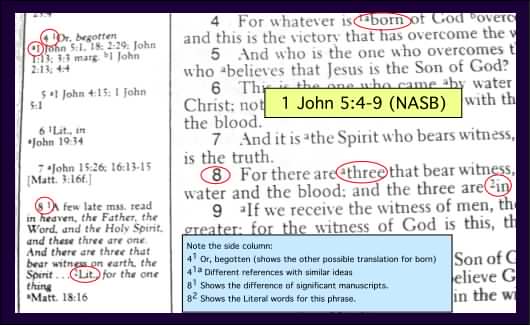
The most helpful versions include a narrow column of Bible verses that refer to other similar verses in the Bible (ie. cross references). The online Bible helps on the internet make this easy. These references might lead to another New Testament verse or one from the Old Testament. The column like the picture above also have a few comments about another possible rendering (i.e., translation) due to other manuscripts using a different word.
Conclusion: The Bible is used for different purposes depending on the occasion. We should at least have one ‘word-for-word’ study Bible even if our church chooses to use another easier to read Bible in the pulpit. Bible study and meditation require them. Yet, let us not be too hard on those ‘thought-for-thought’ translations that enable us to better grasp the meaning of larger portions of scripture. Each has its advantage.
#3 Dependability of English Bible Versions
This section gets a bit complicated. One might want to first read the page on the Reliability of the Scriptures before reading on. Deciding on Bible versions for some people have to do with what Bible manuscripts that the version is based on.
Some people get dogmatic about their one version (usually those who use the King James Version). Some of their arguments are askew. They do, however, have a few points that need to be remembered. If you want to understand this topic, there are numerous things one has to learn. We have put them in list form to simplify things.
Let's RememberIt really doesn't make too much difference. |
The ChoiceFinding the right Bible. |
• We should be glad that we have so many versions of the Bible in English. This is not true with any other language. • The Bible version is not as important as the warm response of our heart to God’s Word. Remember the Parable of the Sower. If we read and not do God’s Word, then we will be like the foolish man that built his house on the sand (Matthew 7:24-27). •If we are concerned with accuracy, we have the option of having two, three, or five Bibles open before us. God, however, can certainly speak to us through any version of His Word. •The originals (autographs) were inspired. We don’t have these, but we do have more than 5,500 NT manuscripts that are extremely close to the originals. • The King James uses a different approach to evaluate the best texts to be used than in most other modern versions. •n the end both systems (Received Text (KJV) and Critical Text (NASB, NIV) use the same process of prioritizing the best manuscripts and discerning which is the most reliable text to be used. • The two systems differ in which way they choose their main supporting texts. - The Westcott-Hort approach is used for most modern versions. They simply should not have virtually bypassed the value of 99% of the manuscripts by their preference over two main codices (collection of manuscripts into a book). This selection, namely Sinaiticus and Vaticanus, is based on the philosophy that ‘older is better’. This can be debated by seeing that some authorities rejected the Vaticanus. Today’s modern versions follow this trend and therefore accentuate the problem of neglecting the majority of the manuscripts. -The Received Text (Byzantine or majority texts) is used for the KJV and the NKJV. These supporters have not been objective enough either. They act as if the Received Text has not gone through the process of selecting and prioritizing different manuscripts upon which to base their English translation. It has. Without understanding this process, they put undue confidence in one man’s judgment (Erasmus). Furthermore, the evaluation of the accuracy of manuscripts does not mean that one does not believe in verbal plenary inspiration. |
• Bible versions are necessarily formed from different collations of Bible manuscripts and the comparisons of the individual passages. This cannot be avoided. There is no perfect translation. • Fortunately, the variations of the manuscripts only affect a tiny amount of Bible passages. None of them affect any key doctrine. • God is able to work through all the versions and translations which is now in use. The Septuagint (LXX) was the Greek translation of the Hebrew scriptures used in Jesus’ day. The resulting translation varied from the Hebrew text in places. Jesus didn’t criticize that poor translation of the Old Testament, but He did criticize our hearts! The interesting aspect is that this didn’t hold back the writers of the New Testament from freely quoting from it. • We should strive to have the most accurate translations, utilizing the most accurate manuscripts. However, it’s a process. Languages can’t be perfectly translated. We need to accept that and not be overly concerned. If so, learn the original languages! The Holy Spirit works through the process. • Because we have many versions, we have ways to make up for the problems. We can simply use two versions to check passages that we are studying. Make sure one is the King James and the other, something like the NASB, ESV, or NIV. If the versions are different, then you will see how minor the variations are. • What version we use really doesn’t make that much difference. When I sit down and use my NASB, I plan to meet God. I could do the same with the NIV or the KJV. He speaks powerfully to me through His Word. As a teacher, I need to be a little bit more careful in making sure that there is no textual problem on a certain verse, but this hardly ever occurs! • Instead of breeding skepticism in the process, we should trust God to work through it. The most questionable passages to be careful of are: Mark 16:9-20, John 8:1-11, and 1 John 5:8. I prefer the longer passages but can understand why some might object to them as being added. I prefer the longer passages but can understand why some might object to them as being added. • Most other concerns are very minor. For example, a verb tense might be in question. Is it past or future tense? Or should we use ‘our’ or ‘your’? Manuscripts can differ with each other. It is hard to decide! Bible translators have to make a decision for their translation, but they realize they can’t be dogmatic as to which was the original. A good Bible will state significant variants in the side margin. |
If you have specific questions about some of the texts that the modern versions have allegedly adulterated, please click here for a full discussion. Many espouse the King James Bible because they believe that the other versions are corrupted. A brother wrote asked about five of these supposedly perverted texts. I delved into it for those who are interested.
A Conclusion
Some people assert certain manuscripts as more reliable than others. That is fine. Their faith will do them well.
Other Versions?By the way, if you love another version, write and let me know why. I'll include it in the discussion if appropriate. |
But even with all of these questions, we still can have hold wonderful teaching times using the thought-for-thought NIV Bible! All the work that is done behind the scenes is very thorough. To be sure more studies will produce more accurate texts, but it takes a tremendous amount of work.
I personally find that there is more question about the real meaning of Bible passages from plain word studies than about the texts themselves. In Hebrew, for example, a single verb might have ten or more possible English translations! Which one is the right one? It is largely decided by context. For speed, I rarely use my Hebrew and Greek Bibles in book form anymore but free online resources. I can point or click on a word and up comes an abbreviated summary of the word’s usage, complete with the Hebrew and Greek word (netbible.org). The availability of these resources will lead to more accurate and reliable texts in the future. Any version, now however, can be used and checked in a moment by such a program.
The more important thing is to meditate on God’s Word day and night. Believe in God’s Word as Christ did. Be a doer and not only a hearer.
Knowing about God’s Word and its reliability is important, but it’s more important to get to know God through His Word!
Other Articles on the Origin of the Bible Series |
|
1. How is the Bible different today from before? |
|
2. How did the Bible come into being? |
|
3. Why aren't other books part of the Bible? |
|
4. How is the Bible different from other books? |
|
5. Doesn't the Bible have a lot of mistakes? |
|
6. Is the Bible really relevant to my life? |
|
7. What Bible version should I use? I'm confused. |
|
8. Why do some people say that I must use the KJV? |
|

Expectations | Communing | Burnout | Questions | Study Questions | Testimony | Mueller
BFF Homepage | Top | About us | Pray for us | BFF's Approach | BFF Store | BFF RSS | Topics | OT | NT
Biblical Foundations for Freedom ( BFF )
Rev. Paul J. Bucknell
Follow @PaulJBucknell
info@foundationsforfreedom.net
Scriptures typically quoted from the New American Standard Bible unless noted:
(C) Copyright The Lockman Foundation 1988