
 BFF is now on Facebook! Please visit and join us in releasing God's powerful Word to our generation!
God's peace can help us live above anxieties as we learn to trust in Him!

The Bible Teaching Commentary on Genesis: The Book of Foundations
Commentaries that specialize on training the teacher!
The Canonization of the Bible
How did the Bible come into being?
The Bible's Challenge | Transformation | Canonization| Extent | Inspiration |
Reliability | Relevance | Version
Canonization describes the process by which the community of God's people accept certain scriptures as divinely inspired and authoritative. Note three special aspects of this process:
-
Progressive collection of authoritative scriptures
-
Written by recognized anointed men of God such as prophets and apostles.
-
Recognized and accepted as authoritative by the community of God's people
We need to remind ourselves that no one person or council made a book 'scripture.' God's church through a process over time came to a common recognition which books were indeed inspired.
A. The Old Testament Canon
When the phrase 'the Law' or ‘the Law and prophets' is used, it denotes that which is accepted as authoritative among God's people. By referring to this twofold reference we know that all the present OT books were included. The closely knit Jewish community always accepted these books as divine down to today. Jesus did too.
(1) Daniel 9:26 shows that the two divisions was already accepted by the exile.
Moreover, we have not listened to Thy servants the prophets, who spoke in Thy name to our kings, our princes, our fathers, and all the people of the land. (Daniel 9:6)
(2) This twofold categorization is made ten times in the New Testament.
On these two commandments depend the whole Law and the Prophets. (Matthew 22:40)
... And he was explaining to them by solemnly testifying about the kingdom of God, and trying to persuade them concerning Jesus, from both the Law of Moses and from the Prophets, from morning until evening. (Acts 28:23)
There is no evidence that any authoritative books were accepted among the original books after 400 BC. The Spirit of God had departed from Israel and the continuity of the prophetic line ceased to be. The intertestamental time (400 BC to Christ's time) continued to confirm the same Law and Prophets.
B. The New Testament Canon
The process of canonization for the New Testament is similar to the Old even though the circumstances widely differed.
“What is of special interest is the fact that between the two earliest Bibles in the Christian church there is a recognition of the canonicity of all 27 NT books.” –Norman Geisler in From God to Us |
While the Old Testament was kept confined largely to the Israelite community protected by the temple and the priests, the New Testament was literally spread out across the world through the Greek copies and different language translations.
Christians were wondering which books should they teach, which would they die for and what books taught the truth. Cults produced their own set of books. A heretic named Marcion in the second century AD said that only Luke and ten of Paul' s epistles should be part of the New Testament. This forced the church to formerly recognize which books really were authentically scripture.
We know more of the process of canonization for the New Testament because of many secondary documents. That having been said, the process was similar to the Old Testament. Canonization happened over periods of time as the community of God's people became familiar with the different books and got copies of them. For example, some books were written to certain places such as Rome (Romans) or even to individuals (Gaius in 3 John). It would take a good amount of time before the document circled back to Antioch, Jerusalem and the other Christian communities. Those books that were questioned were often excluded from one part of the church.
 Note how Colossians 4:16 describes how the book was to be passed around.
And when this letter is read among you, have it also read in the church of the Laodiceans; and you, for your part read my letter that is coming from Laodicea.
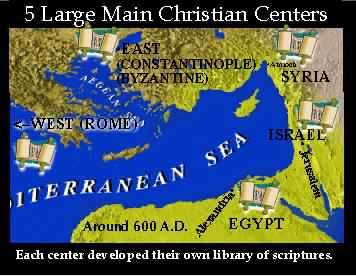
As time went on, the 27 different documents (Bible books) would travel about and end up in different Christian churches or Christian centers. Each main Christian center would begin their own collection of these NT scriptures (ie.manuscripts) by making their copies. Some books might never get to another center. This would produce some question whether the book was authentic.
Most books were easily accepted. The authenticity of others was debated. Twenty of the twenty-seven books were clearly accepted by 180 A.D. (see Extent of Scriptures). Athanasius as the bishop of Alexandria listed the twenty-seven books in 367 A.D. The Chalcedon Council merely affirmed what had already been clearly established in 451 A.D.
Norman Geisler and William Nix's "From God to Us" or "A General Introduction to the Bible" have been used in some references throughout this series. We heartily recommend this book for further study of the Bible's origin.
Other NT references, early church fathers, translations of the NT, and ratification of the 27 books by the Councils of Hippo (393) and Carthage (397) all give us without question full confidence in the 27 books of the New Testament as we know it today. |
Knowing about God's Word and its reliability is one important matter, but one also needs to know how to meet God in the scriptures.
Other Articles on the Origin of the Bible Series |
|
1. How is the Bible different today from before? |
|
2. How did the Bible come into being? |
|
3. Why aren't other books part of the Bible? |
|
4. How is the Bible different from other books? |
|
5. Doesn't the Bible have a lot of mistakes? |
|
6. Is the Bible really relevant to my life? |
|
7. What Bible version should I use? I'm confused. |
|
8. Why do some people say that I must use the KJV? |
|

Expectations | Communing | Burnout | Questions | Study Questions | Testimony | Mueller
BFF Homepage | Top | About us | Pray for us | BFF's Approach | BFF Store | BFF RSS | Topics | OT | NT
Biblical Foundations for Freedom ( BFF )
Rev. Paul J. Bucknell
Follow @PaulJBucknell
info@foundationsforfreedom.net
Scriptures typically quoted from the New American Standard Bible unless noted:
(C) Copyright The Lockman Foundation 1988