
Abiding in the God of Peace
Philippians 4:8-9
– a Life Commentary –
Paul J. Bucknell
Purpose
Philippians 4:8-9: Finding the Peace of God – a Life Commentary shares here the second part Philippians 4:8-9 with diagrams – a way to overcome worry. This is the third part of a three-part series.
After Paul in Phillipians 4:1-7 speaks of five necessary qualities to have the peace of God to guard our hearts and minds in Christ Jesus, phase 2 begins. This phase II “Abiding in the God of Peace,” provides specific guidelines in Philippians 4:8-9 on how to live in God’s peace by our closeness with Him.
Abiding in the God of Peace
Phase II: Philippians 4:8-9
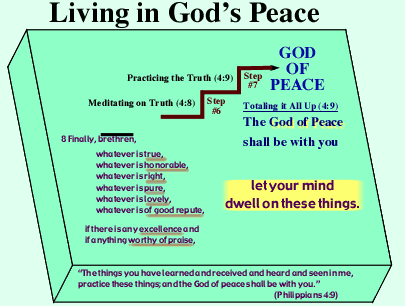
The apostle realizes that the peace of God is good but not our final goal. We need to go deeper. Our goal needs to be in God's presence. We are to abide in the 'God of peace'.
These verses strongly confirm what we have been trying to point out during our study on meditation. Meditation on God's person, purpose and ways brings us to where we need to be. As long as we are focusing on the truth, we cannot believe a lie. We again see the renewed mind of Christ described. A renewed mind brings stronger faith.
Let's now continue with Phase 2 from verses 8-9. This will bring us up two more steps.
Phase 2: Philippians 4:8-9
Step #6
Focusing on the Truth (Phil. 4:8)
Paul shifts into a high gear for here the mind is wholly captured on the good and beautiful. Although the Christian is told what to think upon, we should not think this to be legalistic or restrictive. In all actuality, this is the greatest liberation possible for our minds on earth.
By dwelling on what is good and true, the nasty, ugly, worrisome, and similar things are simply not possible.
"Finally, brethren, whatever is true, whatever is honorable, whatever is right, whatever is pure, whatever is lovely, whatever is of good repute, if there is any excellence and if anything worthy of praise, let your mind dwell on these things" ( 4:8).
◊ As if the mentioning of the Christian duties to get the peace of God or the actual mention of the peace of God, Paul shifts into high gear. Capsizes it all in verses 8-9, but even more gloriously.
• 'Finally' doesn’t signal the end or near to end but final command.
• Generalizes the best and noble qualities possible.
• Think on these things. Not so much mind control as purposely meditating on the worthwhile things. Contrast this to watching a television. Show where one battles to hold to the fight where one might see something good to justify ones time there.
Application
Contrast this focus to watching a show where one battles in his conscience that it is not 'too' bad.
Memorize these verses. Accept these standards. Begin to discern whatever you think with this list. If it is not on the list, then change what you are thinking about.
Let your mind dwell on these things.
This practice opens the shades to receive God’s peace. Settles a mind on what a mind should think about. Remember. This command purposely emphasizes its ability to cope with any nasty disquieting thoughts as well as continually bringing ones mind more in align with His person through limitless good thoughts. Have a One a Day.
Step #7
Practicing the Truth (Phil. 4:9)
The more clearly we see and understand God's truth, the more we can apply these principles to our lives.
The end purpose, though, is not peace of mind but having that peaceful mind which brings forth good works out of love.
These things we are to practice these things.
• God has high standards and expectations for us all.
• He doesn't list rules for getting peace. Peace is goal with the Lord, making His priorities your priorities.
"The things you have learned and received and heard and seen in me, practice these things; and the God of peace shall be with you" (4:9).
◊ Many might wonder what has replicating Paul’s life and teaching has to do with peace. The more clearly we see and understand God’s truth, the more we can apply these principles to our lives. If we see and pretend blindness, hear and act deaf, understand yet become numb, then in this degree you have wondered not only from God but the God of peace.
• Replicated: Biblical Christian is the happy one. (cf. I Jn 1:1-4)
• God has high standards and expectations for us all.
• Doesn’t list rules for getting peace. But also can’t say peace can be received by doing this or that. There are detectors of peace. Peace is a life with the Lord, making His priorities your priorities.
Application
Paul is bringing the highest standards that he knows of to their lives. He lives what he preaches. This is discipleship.
-
What are the good things you can imitate in the leaders around you?
-
Have you required yourself to imitate them or do you think it is unnecessary? Ask the Lord to help you be more aggressive in growing in Christ.
As summary superbly capsizes the goal of the Christian to attain the greatest Christ-like quality possible.
Total: God of Peace
....................................................................
Ro 15:33, 16:20; II Cor 13:11; I Th 5:23; He 13:20.
◊ Where are we left with this? With God! We treasure God’s presence; well, now let us treasure the presence of the God of peace. Before Him, we stand stripped of all our worries and doubts. We live in His comfort. His will is peace.
Anything in align with Him will see the smile of peace upon their lives. But oppositely true too, the wicked have no peace. They are like the rolling waves of the ocean soon to meet their doom.
Summary
Is genuine peace that hard? No. Is it worth it? Yes. This sums up our call in life and our hope in the future that when we see the Lord that He rewards us. This also practically speaking is the only solution for your individual disquiet or our church’s disunity. We cannot be content with the peace the world gives. It’s fake and phony.
The Lord has a greater peace that originates with Himself. We cheat ourselves, our families, our church and our witness to the world when we don’t pass on the true peace of God. It is involved but needy and worth every step.
But let me encourage you with the simplicity of obtaining God’s peace. The simplicity of His peace seems to get lost in the screen of commands. However if you take a look at those very commands, you will find that things are simple as responding to the God of peace. As a non-Christian.... As a Christian, you will notice how.
God’s peace is the most simple life. The wicked and mask-wearers confuse others and themselves with lies, false pretensions and false reports. God’s peace brings you to be honest with yourself and yet with a clearer goal than ever of being more like Christ. (I Jo 3:2).
 If we found the peace of God to be the subtotal, indeed the 'God of peace' is the total. "And the God of Peace will be with you." We are left with God!
If we could treasure the peace of God before, so now let us all the more cherish God's presence. Before Him, we stand stripped of all our worries and doubts. He Himself is our confidence. We live in His comfort and protection.
Anything in conformity with Him will experience His peace, but the opposite is true too. The wicked have no peace. They are like the rolling waves of the ocean soon to meet their doom.
Is genuine peace impossible? No. Is it worth it? Yes. These verses sum up our Christian call in this life. With these assurances, we can see that the worries, stresses and fears of this world are void of God. We dare not be fooled that these things are natural. They are at best ugly contortions of life. At worse they are vital signs of death.
Summary
We can cast our worries aside only to the degree that we embrace the truths of God. We only can cast darkness aside, if we bring in light. As we draw near to the other side, we are not only drawing near to peace, but also are drawing near to God Himself. Finding peace is discovering God. Below is a summary chart of Philippians 4:2-9.
See a handout on the seven Steps to Finding the Peace of God.
Click to continue to the next article on Philippians
This article is one of many waiting for you to read from the BFF New Testament Library - see below.