
Going into His Harvest — Matthew 9:35–38
A Teaching Summary
A preaching outline and teaching summary of Matthew 9:35–38 showing the urgency of reaching the harvest through Jesus’ example, compassion, instruction, and call to prayer.

What is one of your most difficult Bible verses? Mine comes from this text. It is not that I did not care about telling people about Jesus. I did care. I told many people about Jesus, but what I experienced was so different from what Jesus says. Jesus said, “The harvest is plentiful.”
A link to my experiences and in-depth exposition on my newer website is at the bottom; here I provide a teaching summary of Matthew 9:35–38. Ultimately, I discovered I had the wrong perspective. I couldn’t see things as Jesus did.
Let’s look at this passage together and see what Jesus does say. After all, Jesus did more in three short years than all of us together in our lifetime. Let us first look more carefully at Matthew 9:35–38.
Jesus was going through all the cities and villages, teaching in their synagogues and proclaiming the gospel of the kingdom, and healing every kind of disease and every kind of sickness. Seeing the people, He felt compassion for them, because they were distressed and dispirited like sheep without a shepherd. Then He said to His disciples, “The harvest is plentiful, but the workers are few. Therefore beseech the Lord of the harvest to send out workers into His harvest.” (NASB used unless otherwise noted.)

Introduction
Observe the disconnect between Jesus’ words—“The harvest is plentiful”—and our discouraging evangelistic experiences. Despite active outreach, few seemed receptive. Over time, the issue becomes clear: the problem lies not in the harvest itself but in our perspective and understanding of God’s ways.
A. Jesus’ Itinerary (Matthew 9:35)
Jesus modeled an active, outward-focused ministry by going, teaching, proclaiming the Gospel, and healing. These actions reflect His deep commitment to reach people where they are—physically, intellectually, and spiritually. Believers are encouraged to similarly go beyond comfort zones and minister actively, recognizing that Christian service is not limited by location or status but propelled by love and obedience.
- Jesus’ movement parallels the Great Commission.
- Ministry includes both structured teaching and open proclamation.
- Healing was a visible sign of God’s kingdom power, often neglected today.
- Our ministry should mirror Christ’s actions, combining word and deed.
B. Jesus’ Insights (Matthew 9:36–37)
Jesus’ compassion stemmed from truly seeing the people’s needs—they were distressed and helpless, like sheep without a shepherd. We need a similar lens of compassion, seeing people not merely by their roles but as souls in need. Jesus knew the harvest was ready even when it did not seem obvious. The true problem is not the readiness of the harvest but the lack of willing workers.
- Compassion begins with seeing people’s spiritual condition.
- Many Christians do not act because they underestimate human need or overestimate comfort.
- The Father sees a ready harvest and grieves the shortage of laborers.
- Believers must adopt the Father’s urgency for reaching the lost.
C. Jesus’ Instruction (Matthew 9:38)
Jesus commands prayer—“beseech the Lord of the harvest”—as the key starting point for kingdom work. Prayer aligns our hearts with God’s and initiates action. We must go ourselves and intercede for more workers, refusing complacency and praying with obedience, compassion, and urgency.
- Prayer is not optional; it is Jesus’ command and the launch point for action.
- God uses our prayers to mobilize others and change hearts.
- Going and praying are linked—we must not merely observe but participate.
- The urgency of the harvest demands immediate and bold responses.
Conclusion
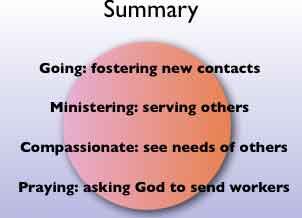
- Going: fostering new contacts
- Ministering: serving others
- Compassionate: seeing the needs of others
- Praying: asking God to send workers
Did you see that Jesus said the harvest is “His harvest”? He has everything all arranged. He is waiting for us to call upon Him. Are we calling? With compassion? With regularity? With urgency? The harvest is plentiful. May God raise up from here great harvesters for His kingdom! Waves of judgment are threatening the crop. We need to act now.
The teaching is Paul J. Bucknell’s; AI assisted with portions of the summaries.