Melchizedek is an intriguing Bible character, largely because he is only mentioned in three sections of Scripture. Each time this high priest plays a significant role. We will briefly discuss the later two places where Melchizedek is mentioned so that we can begin to understand what God is teaching us through this high priest–king: Psalm 110 and Hebrews 5–8.
Whether Melchizedek had his own army or was accompanied by God’s spiritual army of angels, we simply do not know. Nor are we sure how much Abram understood about these things. He did, however, and this is important, recognize the vital part God played in the victory that enabled him to rescue Lot. This is our first introduction to the important place of Melchizedek in God’s plan.
Our understanding of Melchizedek must in part come from our understanding of Jesus Christ, of whom Melchizedek was a type. There are only two other sections of Scripture where he is mentioned—one in the Old Testament and one in the New.
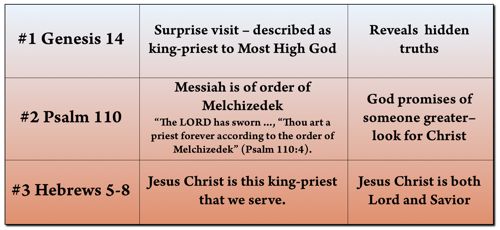
The psalmist writes of the Christ, the Messiah, “The LORD has sworn and will not change His mind, ‘You are a priest forever according to the order of Melchizedek’” (Psalm 110:4).
In verse 5, which relates closely to Abram’s experience, we read, “The Lord is at Your right hand; He will shatter kings in the day of His wrath.”
The Book of Hebrews picks up the theme of Melchizedek and explains much more about him. Starting at the end of chapter 4, the author speaks of Jesus both as a great high priest and as king—the Son of God:
“Therefore, since we have a great high priest who has passed through the heavens, Jesus the Son of God, let us hold fast our confession. For we do not have a high priest who cannot sympathize with our weaknesses, but One who has been tempted in all things as we are, yet without sin. Therefore let us draw near with confidence to the throne of grace, so that we may receive mercy and find grace to help in time of need” (Hebrews 4:14–16 NASB).
Hebrews chapters 5 to 7 give great significance to Melchizedek and to Psalm 110. Melchizedek is not only a type of the coming priest–king, Jesus the Messiah, but this new priest–king also represents a new covenant. Because Psalm 110 was written after the Law (Exodus–Deuteronomy), the Old Testament itself declares that a greater priest, king, and covenant than the Mosaic one would one day come.
 All of this is fulfilled in Jesus Christ, who established the New Covenant.
Jesus is both our priest and our king, to whom we are fully obligated as servants.
We give gifts to God through the way we give to the local church, with a purpose
similar to Abram’s, showing our gratitude and dependence.
All of this is fulfilled in Jesus Christ, who established the New Covenant.
Jesus is both our priest and our king, to whom we are fully obligated as servants.
We give gifts to God through the way we give to the local church, with a purpose
similar to Abram’s, showing our gratitude and dependence.
Jesus told us to pray to the Father in His Name. Jesus is the mediator who has all authority in heaven and on earth. When God puts something on our hearts, we are to go to the Father in prayer, asking Jesus the High Priest to bring our needs before the mighty God, the possessor of heaven and earth. In this way our prayers are answered.
In response, touched in our hearts by God’s intervening grace, we further devote ourselves to this almighty God. So what are we to understand from all this?