Knowledge and Good Decision-Making
Paul J.Bucknell
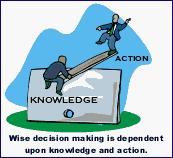
Good decision-making is dependent on two essential components: knowledge and action. There are, undoubtedly, many other important aspects to making wise decisions. However, possessing the right knowledge and having the determination to follow up with the right action are essential to this process.
This article largely discusses the knowledge that we need to make right and good decisions. The place for determination or action in decision-making will be discussed briefly at the end. We will first focus on how what we know 'our knowledge' affects wise decision-making. Later, the importance of following up this knowledge with action will be discussed.
Seeking God's will or your own?

Many have the right knowledge but using that knowledge is part of making wise decisions. For example, there is a plethora of knowledge about condoms and STDs. However, not many people use that knowledge in making decisions.
Knowledge and Decision-Making
For convenience, let us focus on three areas of knowledge. Each area can be further broken down. For certain individuals, different categories of knowledge will be important to identify. There is experiential, historical and spiritual knowledge. Having a certain component of knowledge enables one to make a right decision. Let's discuss each of these.
(1) Experiential Knowledge
Experiential knowledge includes what we have learned by experience. This is what the modern person chiefly focuses upon. They emphasize 'what they feel is right.' Each person has their own lessons of life which would include their education, experiences, circumstances while growing-up, etc.
They are all blended together through an unconscious process and become what we call experiential knowledge.
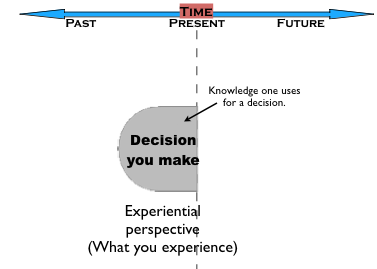
Today's world emphasizes that each person has their own set of experiences which encompasses different learning arenas. It further asserts that we should be tolerant of each and every individual and the ensuing decisions that he or she makes. Using this philosophy, others are not allowed to say premarital sex, for example, is right or wrong.
This will be up to what a person knows and chooses. Each person's knowledge is valued because each person is valued. It is further stated that if we evaluate a person's decisions according to our standards, then we devalue the individual who made the standard.
This philosophy of personal knowledge has severe problems. This whole philosophy is built on the perspective that a person's knowledge always leads to the best decisions. But, surely they do not. Divorcing the person one married just months before, brings great emotional trauma, financial loss and moral offenses. Personal knowledge is often insufficient to make wise decisions. If they had some foresight to the problems they would encounter after they got married, they probably would never have even gotten married.
By refusing to use knowledge other than personal knowledge to evaluate a person's decision, we guarantee poor decision-making. They cannot learn from the advice of others. They cannot learn from God. It is up to the individual to find the knowledge that they think pertains to their situation.
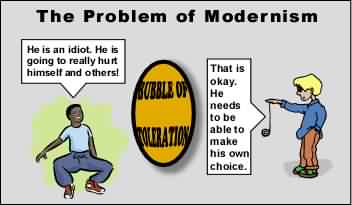
Modern philosophy, in the guise of making people precious, so-called protects everyone's decision in a bubble of toleration. Modernism's need to protect its liberal policies and so-called 'choice' actually leads to hurt and pain. They are concerned more with preserving their freedom of thinking and lifestyles even though it brings great pain and trouble to the lives of people who surrender to this system of thinking.
This mentality, in fact, devalues people by encouraging them to live under the burdens of their poor decisions when they could make wiser decisions that lead to greater blessings. We keep knowledge from them and thus let them suffer. Let's look at another arena of knowledge. If they could add this to their experiential knowledge, they would bypass many of the blunders poor-decision makers are making today.
(2) Historical Knowledge
Historical knowledge significantly broadens one's knowledge. We have heard people rightly say that the study of history enables us to not repeat history. That is, if we learn from the past, then we will not make the same mistakes in the future.
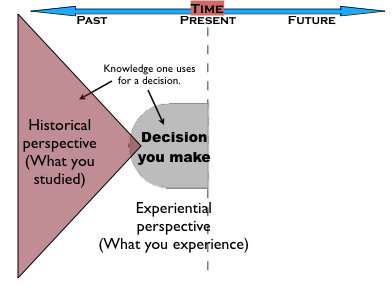
Historical knowledge includes all sorts of information. Anyone doing research looks at the past reports to see what else was written in the area of study. Financial investors are very interested in past financial profits and decisions to help them get a grasp on whether a company might be a good investment of their money. The past does not dictate the future and cannot guarantee certain future results, but it does give us a better understanding of the right factors that might preserve that invested capital.
Of course, historical knowledge is dependent upon the one who wrote it and the one who interprets it. In this sense, history is very limited. The author of the records could very well be biased. Today's revisionists guarantee a biased report which so skew the facts incorporated in the report that the information becomes misinformation. History becomes fiction in the hands of the authors. They write what they want people to think of the past.
Let's think about science for a moment. Natural scientists are trying to get a clear picture of the world's past. The author's interpretation of fossils and earth strata greatly shapes the readers' perspectives. A great number of reports have come out in the past decades depicting a long history of earth such that most people now take the long history of earth as fact. But, it is the confidence of the author more than the facts that convey this perspective. What is now called history of man is not necessarily true at all. It is a projection of what happened. If people are going to be helped, then they need people to better identify their bias when making their reports.
Another example of this is in biblical archaeology. Most archeologists actually do not believe that Israel had an 'exodus' out of Egypt. They believe the Israelites developed right in Palestine. With this perspective, they write their reports about their findings.
Some of the facts are true about what was discovered. But their interpretation as to how it fits into the timeline and history itself is not definite as they would believe. Even recent history can be rewritten from the perspective of a person's viewpoint. Those that favor the Nazi perspective will slant their past studies in such a way to promote a positive viewpoint of the Nazi party even though it was responsible for many mass murders.
If we are going to learn from history, we need to discern the perspective of the authors and take this into consideration. This is true of research, financial reports, archaeology or modern events. If we can understand the approach in which articles were written, then we can more clearly identify the actual truth of what happened. No report is free from bias. I myself write with a strong conviction that what is in the Bible is true; the Bible is written mainly to help us. If you understand this conviction of mine, then you can better discern the substance of any arguments I make.
We can all profit from a study of the past. It enables us to gain the wisdom of past situations and to observe what might happen in a certain setting. Certainly it helps us realize that our own personal understanding can be far too limited for making a wise decision. We can widen our perspective through studying how other people in the past have approached the problem in a given situation.
Gambling is becoming an increasingly legalized activity. What used to be limited to a few remote areas has now become quite popular. Governments and individuals are seeing gambling (which they wrongly call gaming) as a means to gain revenue through taxes, employ the jobless and simply make money.
If we need to make a decision on whether we will allow or encourage gambling in our city or whether we will personally allow our own family members to go to casinos, we certainly need to go beyond our personal experience. We might not have any experience in that area. Or we might simply hear how others have enjoyed their experience at the casinos who entice people by great buffets and hotel prices.
A historical perspective would enable us to see the development of the gambling trade as well as the economical and social impact on a given society or family. A wise decision calls us to get all the information that we can. Reports that exclude certain data as the increase of crime, social ills, suicides, etc. would pervert our decision. We need to insist on getting the right information so that we can make the best decision with the most fruitful results.
But a study of the past is limited. Our understanding needs to go beyond this to get a right understanding. At this point we have been focusing only on knowledge of the present and the past. Our knowledge of the past is impaired by the limits of available and correct knowledge. But what about the future? Let us look at the next area of knowledge that is necessary to make wise decisions.
(3) Spiritual Knowledge
For most people, this category of knowledge makes absolutely no sense. For many, spiritual knowledge is naught. It doesn't exist. For others, it is limited to personal experiences that would best fit under the first category. In fact, spiritual knowledge is that knowledge that is revealed by God to us so that we can make wise decisions. It does not include all knowledge. We would need to be God to make use of all knowledge. Indeed, it does not provide us with all knowledge, but it provides us with all the significant knowledge that we need to know in order to make a right decision.
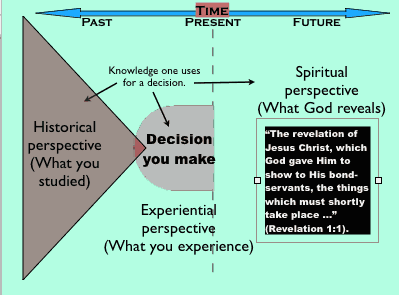
Usually when we think of revelation of God, we associate it with the future. Prophecy, for example, often addresses future circumstances. It reveals knowledge about future events so that we can make wise present decisions. But God reveals knowledge about the past and the present too. For example, creation is a revelation of God about the past that should have large influence upon our materialistic perspectives. Exodus (the Ten Commandments) should have a great influence on our system of justice.
These thoughts were not derived by man. Man cannot take credit for these things. That would confuse everything, though we recognize that some suggest that (we will not defend our opinion here but only explain it). Perhaps, the best way to show you what we mean is to take a look at Revelation 1.
The Revelation of Jesus Christ, which God gave Him to show to His bond-servants, the things which must shortly take place; and He sent and communicated it by His angel to His bond-servant John, who bore witness to the word of God and to the testimony of Jesus Christ, even to all that he saw. Blessed is he who reads and those who hear the words of the prophecy, and heed the things which are written in it; for the time is near. (Revelation 1:1-3).
The Book of Revelation is even more special in that it calls itself as a 'revelation.' It is knowledge that we would not have, apart from God's special revealing. In this case, God gave special knowledge to Jesus who, in turn, revealed it to an angel to communicate it to John so he would communicate it to us - God's people. Pretty special, isn't it? But why was this grouping of insights given to us? The reason was given in Revelation 1:3.
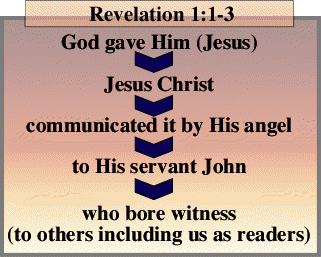
As it says in Revelation 1:3, "Blessed is he who reads and those who hear the words of this prophecy, and heed the things which are written in it; for the time is near."
Throughout this book, we are given a perspective that is designed to radically shape how we make our decisions. This book is more blatant about it, but it is true about the whole Bible. It is our responsibility to take God's Word and apply it to our lives.
This simply means that we need to see which aspect of the Word of God is relevant to our decisions during the day. The good part is that God is really on our side. He wants to help us make the best decisions possible. (Why is it that people think that God is trying to negatively interfere with our lives anyway?) Let us look at one simple passage from the Book of Revelation.
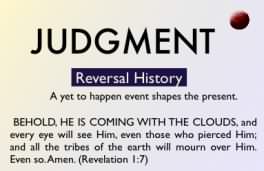
BEHOLD, HE IS COMING WITH THE CLOUDS, and every eye will see Him, even those who pierced Him; and all the tribes of the earth will mourn over Him. Even so. Amen (Revelation 1:7).
This passage is about the future. It gives us insight into what will happen in the near future. We know that the passage is clearly speaking about Jesus Christ's second coming. He came the first time to die for us and bring salvation. The second coming, as inferred here from the mourning, will be judgmental in nature. We also see that it will impact everyone, believer or not. Muslims and atheists will not be excluded. His coming will be majestic rather than humble as His first coming.
This is one future event that should make a big difference in our lives. Because of this truth mentioned above, what we do with our present lives will have eternal consequences. Many people disregard the scriptures and therefore make improper decisions. They are not thinking about the future. They perhaps do not even know how to think about the future.
Jesus mentions one wealthy man who made a lot of money from his crops.
And he said, "This is what I will do: I will tear down my barns and build larger ones, and there I will store all my grain and my goods. And I will say to my soul, "Soul, you have many goods laid up for many years to come; take your ease, eat, drink and be merry." But God said to him, "You fool! This very night your soul is required of you; and now who will own what you have prepared?" So is the man who lays up treasure for himself, and is not rich toward God (Luke 12:18-21).
 This man was blinded from God's perspective and ended up making some foolish decisions which in most people's views looked wise. He built larger barns to hold more crops. If he could see that his life would be so short, would he make different decisions on what to do with his wealth? Jesus believes so. Would he make different decisions what to do with his wealth and life if he knew he was going to soon die? Probably so.[1]
We sometimes boast in how much our knowledge of a certain area helps us make wise decisions. But much more important is the apprehending of the spiritual insight that is needed to make wise decisions. If we see the importance of this, then we should adjust our lives and make room to seek and find God's revelation. We ignore it to our own peril. But blessed is the one who reads and hears and most of all takes 'heed' or action in carrying out what one knows is right.
John, in Revelation, writes that this one great event of Christ's return should overshadow all of our lives. It is true even (thought) though it has not yet happened. Consider it reversal history. It is fact that is waiting to be recorded. That it has not yet happened doesn't make any difference. It is true and personally relevant; therefore we should insist on it making its impact on our lives right now. Christ's coming is a fact and ought to hold an important influence on the decisions we make.
Spiritual revelation has a lot to say about different aspects of life. We learn the importance of life, the value of living according to God's standards and the importance of keeping God's purpose for things in mind. Our materialistic world pressures us to make decisions without this input of spiritual knowledge.
This spiritual knowledge guides us in decisions such as staying sexually pure even though it goes against what we hear around us. It helps guides us through slanted reports about the favorability of sexual exploration. We trust this spiritual knowledge and find it actually affects many aspects of our lives. We do not need to know about HIV, condoms, STDs, etc. if we are faithful to our spouses all our lives. God as our Designer has released guidelines on the most optimum life. -> Next
Good Decision-making and Knowledge
Good Decision-making and Action
Good Decision-making - study guide
Notes
[1] It is wrong to hide the fact of approaching death from patients. It is much more important to discuss such things. If they need to make certain decisions to straighten out their lives, then we should by all means give them opportunity to do so.
More Basic Discipleship materials
 If you would like, you can order the BFF Discipleship #1 Training Library which has many helpful discipleship resources including this series.
These materials can be read, printed out and used at your convenience. A more complete description is at the BFF Resource Center.
BFF Basic Christian discipleship materials
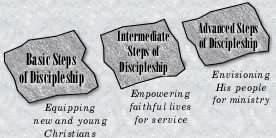
BFF has three sets of basic discipleship materials with slightly different objectives.
3 X E: Trains new or untaught believers basic teaching to ground them in their faith and integrate them into the church. ...More
Cross Trainers: Many new believers do not understand how to have good relationships with others. Cross Trainers uses biblical models to help struggling believers have great relationships with God and others. ...More
Life Lessons: Many believers do not know how to teach or disciple new or young believers. Life Lessons shows how to train new believers through short videos and handouts. ...More