
Godly Beginnings for the Family Index
Starting Families Right | Family Commitment | Family Planning | Husband & Wife Roles | Family Health Plan | Preparations for Childbirth | Tender Newborn Care | Challenge of Child Training | Disciplining & Training Small Children | Setting up Godly Routines
Godly Beginnings for the Family
Paul and Linda J. Bucknell

Tender Care for the Newborn
Purpose
Tender Care for the New Born is part #5 of the Godly Beginnings for the Family book which gives helpful insights how to care for mother and baby right after birth including setting up a routine and dealing with the issue of work after birth.
Learning how to care for infants, before, during and after birth!
God has not only created an astonishing birth process but also the marvelous nurturing process. God has designed that the mother’s warm embrace, provision and soft voice not only meets the child’s physical needs but begins the very long process of training the heart of the child. God clearly designed woman with all her features.
The first woman, Eve, received her name from her distinct ability to bring life into the world. ‘Eve’ means ‘living.’ The mother can completely trust God not only with the multiplicity of complicated events happening during the birth but also that the special nursing procedure meets the special needs of the newborn.
But women shall be preserved through the bearing of children if they continue in faith and love and sanctity with self-restraint (1 Timothy 2:15).
 Throughout this lesson we will pay special attention to the post-birth needs of the Mom and newborn. Some things might seem basic to you. That is fine. We are especially concerned with those who missed the opportunity to observe their mother caring for younger siblings.
This is happening more and more as family size shrinks. If the family has only one child, that child is likely to miss seeing the mothering process in action. This is one main reason for such an increase in books on the topic.
We encourage you to read two books on caring for infants including one specialized on nursing. You want to build up your knowledge. Doctors are too busy to answer the many questions mothers have. Do be careful though. Many books have a secular and unbiblical perspective.
However, it is also good to have an experienced mother that you can feel free to call anytime. As you approach birth, find a mother that you respect and ask her if she would be available to answer your questions. The main thing is that she is agreeable to receive phone calls at any time even at night. That brings a lot of confidence to the new Mom.
A) Special Care for Mom
What should Mom expect in the first weeks after delivering a baby? What should others expect of her? Let’s start with the last question first. It is good that for the first three weeks or so that the Mother is able to focus on the dual tasks of personally recuperating and caring for the infant.
The mother needs someone to care for the regular household duties. Many cultures have certain restrictions or guidelines for the Mom and the new baby. The Chinese mother, for example, is to observe a month of extended rest and care. No matter what society you live in, it is good to have someone to help with meals, household duties and the other children.
 We have so much appreciated having Linda’s Mom come for a week or two (depending how early the baby arrived!). This kind of arrangement, however, is becoming less and less available. Sometimes parents are unable to help much or they live overseas. This then becomes an opportunity for the church family to help express God’s great love by bringing over meals and giving a helping hand. Our societies and families are not poised to care for others as they ought. We need more of God’s grace.
God has designed the mother’s body to be able to go through intense adjustments during this time. During the end of pregnancy, her pelvic bones loosen so that the baby can be born. After birth, the bones readjust. As the mother gets older, the process includes more aches and pains. Praise God for the way He takes care of the process right down to adjusting the body chemicals through the hormone changes. In any case, we should not think the Mom is ready for house cleaning any time soon!
Since Linda sees the midwife, she comes home about 4-6 hours after the baby is born. She needs to pay more attention to some matters. She often goes through a time when she shivers (even when it is warm). We don’t get nervous but just realize it is part of the readjustment process. There will be some bleeding and pads are needed. Again, if the Mom has been in the hospital for these days, these provisions will be made. Since hospital stays are down to about two days, mothers need to better understand the special post-birth needs.
Of course, any surgery or stitching makes things tender down below. The Mom is concerned about getting rid of that ‘pouch.’ It goes. Sometimes it hangs around a bit longer if one is older (skin is less elastic) or if one was not eating properly before birth. Do not think of this time as a time to diet but to eat properly. The Mom should be eating lots of good nutritious things not only for herself but also for the baby. What the Mom eats will be passed on to the baby through the breast milk.
 The mother needs to ready herself for caring for the infant. Even though others help her in the beginning, the mother should take over these responsibilities as much as possible early on. The nursing and precious caring helps create the close bonding between the mother and the child. Some authors certainly have exaggerated this bonding process, but in fact God has made the mother to be close to the baby. Mothers have a special gentleness that husbands aren’t gifted with.
Godly Beginnings for the Family
Learning how to care for infants, before, during and after birth!

Click to order download (pdf) with study questions, footnotes, etc. or get the powerpoints and handouts.
Click here to view back cover! Smaller | Larger
The mother should expect more naps and less long periods of sleep. This works out fine if the mother is not under any pressure from outside activities. The baby will need to be fed and changed regularly.
God has already been preparing the mother by having her get up during the nights to visit the bathroom before birth. She should expect to feed the baby every three hours at first. This schedule will change after 3-4 months, or when the baby starts to stay awake longer and the length of each cycle is extended. More details on the schedule will be given below.
Breast Feeding
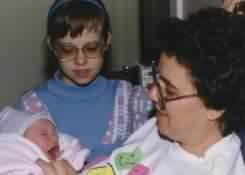 We have noted in an earlier session (#3) the benefits of breast- feeding. Clearly this is God’s way to both provide for the baby’s nutritional needs as well as for love and acceptance. The mother is called and designed to care for this aspect of childcare. As much as she accepts her calling, she will gain grace, strength and love to do a great job. Good mothers live by faith in God’s grace.
Mothers can feel rather awkward when they first try to breastfeed. It is one thing to read books or watch a video of another mother doing it, but another thing when doing it for yourself. The process is quite sensible but there are a few ‘tricks’ that help a Mom a lot so that she does not give up.
The availability of formula makes it easy to give up when encountering a few difficulties. It is so much better to breast feed. The mother’s nipples can get sore at first especially if the baby is not properly latched on.
It seems that Linda has had to relearn the process each time she has had a baby. The midwife or nurse comes and gives different pointers. One should not feel awkward asking questions. Although the milk is there after a few days, sometimes it is not so easy to get the milk into the baby!
Sore nipples can be helped by:
-
Using vitamin E oil or a lanolin based product to keep the nipples supple.
-
Making sure the baby is latched on correctly.
Sometimes formula is necessary. The doctor or nurse should be able to see if the breast is not working properly but this is rare. The baby gets used to the ease by which it can suck milk from a bottle. It is then difficult for the baby to learn how to suck from the breast. The sucking process is quite different. This is the reason it is good for no bottle to be given to the baby early on. Start to nurse the baby right after delivery.
You might be concerned about the nutrition of the baby before the milk comes in. The baby has enough body fat for this transition time. The baby will loose a little weight (up to a pound) after birth before the milk comes in. That is normal. God provides colostrum, the first substance in the breast, to beef up the baby’s immune system. Meanwhile use this time to train the baby to suck, train the mom to feed properly and keep Mom and the baby close together. Water is not usually needed.
There are many other questions that can come up. Fortunately, there are many good books with lots of detail on breast-feeding. Some of the breast-feeding questions that you should learn about include:
-
What does it mean for the baby to be properly latched-on?
-
Does the position of the baby during breast-feeding make a difference? How?
-
What should a mother expect when the milk comes in?
-
What if the Mom can’t breast feed for a day or two? Is it possible to get back on track?
-
How do you deal with engorgement and leaking?
Our main point is that many mothers have such concerns. Learn about them ahead of time so you just don’t give up when you face some difficulty. Don’t think you are the only one to face such problems or are a failure. The mother is learning a new skill.
The Mother, the Nurturer
The mother is God’s appointed nurturer for the child. He has not only provided her physical features for this but also the special psychological design. God has prepared the mother to endure this intensive time of infant care. The mother needs to talk to God often for strength and tenderness to rightly care for the newborn with a proper attitude. Notice the way the mother is described below.
But we proved to be gently among you, as a nursing mother tenderly cares for her own children. Having thus a fond affection for you, we were well-pleased to impart to you not only the gospel of God but also our own lives, because you had become very dear to us (1 Thessalonians 2:7-8).
 This is not the time for the mother to think that her husband should spend equal time caring for the baby. Clearly God did not give him the features, physically or emotionally, to do this. When a couple believes both husband and wife should share equal time caring for the baby, stress increases between them. They both end up being physically and emotionally wiped out. Instead of helping each other, they are bitter and angry toward each other.
Let us be more specific. Sure the Mom could pump so that the father could do the one a.m. feeding, but this is clearly not God’s intention. If the mother doesn’t breast feed, then this tension can increase even more. It should not. The mother should still nurture the baby.
We find it interesting that the Angel of the Lord appeared twice to Samson’s mother rather than the husband. Why? It seems rather obvious. She as the prime nurturer was given special direction on how she was to care for him.
Even more interesting is that when Samson’s father found out and asked about special directions, the angel merely told him, “Let the woman pay attention to all that I said” (Judges 13:13). In normal circumstances the wife cares for such duties. The more clearly the husband and wife can define their responsibilities and accept them, the less stress there will be on their relationship.
The husband and wife, for example, won’t wait for the baby to cry for five minutes hoping that the other spouse will care for his needs. Instead the mother should respond to the baby’s needs as if she were serving the Lord Jesus. She is, after all, caring for God’s new creature.
The Father, the Provider and Overseer
What about the father? Doesn’t he have any responsibility toward his wife and newborn? Yes, but his primary role is one of defender, provider and overseer. The husband will be able to help here and there but should be able to sleep through the night as much as possible for his regular work routine. Clearly his role is not the same as the mother.
He oversees the special needs of the family. Because of this special time, he keeps a closer eye on the needs of his family. If the father can get off from work, a father’s role might be the chief support person for the wife when there is no other help around. In other cases, when grandma is visiting, then the husband can show care for his wife and love his child as occasion provides.
How can the father help? It would be great to take a few days off from work. He can make sure supplies are full and other needs are attended to. Maybe his wife needs a back rub or have an errand run. The mother, however, should not get upset that the husband does not regularly share her hard work in caring for the baby.
Don’t let worldly expectations spoil God’s special plan. The husband should run to help if the baby has a mess that spilled over and the mom needs an extra hand. He should talk to her about special concerns such as the importance of talking with a doctor for some problem. The husband should be praying and taking a special interest in family affairs. If she is burdened down, sick or needy, he should step in and help to see that help is provided. The husband shows his special delight in his wife by staying pure in mind and patiently waiting for his wife to fully recuperate so that they can be intimate again.
A number of husbands openly demand or secretly expect that their wives will both work outside the home and care for children. God wants the wife home caring for the children. It is better that the couple live in a poorer neighborhood with a used car than for the wife to be working outside the home. The scriptures clearly appoint her to care for domestic and child responsibilities. Professional women who become mothers sometimes have a difficult transition time. This again is primarily due to the expectations of others and herself that she should work. It will take time to be fulfilled as a mother.
The father is responsible for setting up a godly home. Decisions need to be made that conform to God’s standards. We can’t have both God and the world. Wives at home face a lot of pressure and the husbands must reinforce the importance of her responsibilities by praising and encouraging her. Although the world encourages the wife to go back to the work force as soon as possible, the need for the to be at home mother go way beyond nursing the baby for a few weeks.
This will be very evident in the next few sessions on training. The things that a young child can gain from a mom’s constant care is much greater than the supposed ‘education’ that a child might get at a nursery or preschool. God’s design is the best and is fully operable within this modern society.
B. Special Care for the Newborn
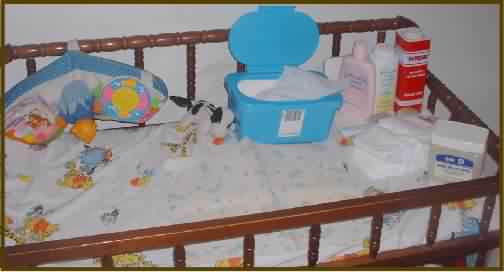 There are many incidentals in order to properly prepare for the newborn. Below we have a picture of a changing table. A high changing spot is very helpful for changing diapers and clothing. NEVER, NEVER leave the baby alone on the changing table.
Diapers: Early on we used cloth diapers but now find that disposables are much better and cleaner. Linda has exema on her hands. Rinsing and washing cloth diapers aggravated this condition. When washing, purchasing and cleaning time is considered; the price is not that much more expensive. If coupons can be found, then they ought to be given to new Moms. There is the option of using a diaper service for cloth diapers.
Vaseline: Petroleum jelly is cheap and yet a great helper. It provides a barrier on broken skin that promotes healing of any diaper rash. Linda personally prefers A&D ointment for diaper rash. The vitamins promote healing. Balmex is also good. It contains zinc oxide also good for healing skin.
Wipes: They are great for good cleaning. Sometimes the child or mom’s hands might be allergic. Damp tissues can be prepared ahead of time. Cotton squares dampened with water also serve the purpose.
Toys: Little toys are for special picture effects. Infants don’t care. When the child is older though, it is good to have their hands occupied.
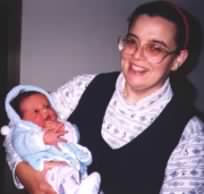 Powder: Not necessary with these new absorbent disposable diapers. But when there is extra dampness or rash, it helps provide a little extra healing. Prickly heat, lots of little red spots, can bothers babies. Cornstarch is also helpful.
Other things: Mom should have on hand a thermometer, nose cleaner, ear swabs and cotton balls. Some of them perhaps would be placed near the bathing area instead.
When the baby is born, the belly button area will need to be cleaned with rubbing alcohol until the cord falls off and is fully healed, not red or weepy. The process works fine. God takes care of everything just so you keep it clean and dry. Remember to be careful when carrying the baby around. We do not recommend having hot items like coffee near the baby. Accidents happen.
Other Matters
Siblings: It is good for your other children to watch and participate as much as possible. They will be best friends in the future. If the older sibling feels left out rather than blessed by the newborn, he may revert to some “baby” ways as a means of getting your attention. Parental attitude toward the new baby-sibling relationship is vital to harmony between them. Little children love to help out. It does take more time for him to “help” you, but it is good training for the older sibling.
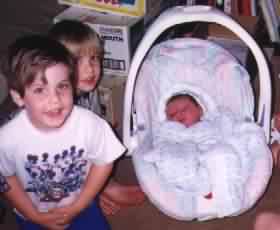 Children are good ‘go-getters.’ Do you need the diaper bag? Have him bring it to you. Let the little one touch the new baby. As they do, emphasize how they are the big brother or sister now.
God has made them to help care for the little one. Start this training early on. This is God’s birth order. There is responsibility built into the relative ages of the children. We are wise if we work with God’s system.
Bathing: Linda uses the kitchen sink to bath infants. Once it is properly cleaned, the sink is high, handy and has a convenient shelf next to it where she can lay the towel and other items needed. Again, never leave the baby alone.
Burping: Some babies gulp down their milk. This is easier to do with a bottle. Without proper burping, the tummy gets air and ‘runs over.’ In breast-feeding, burp the child once or twice during feeding from each side. Do it more if the baby starts to squirm or seems uncomfortable. For the first months, we have a ‘burp diaper.’ When burping the little one, the cloth is put on the shoulder or under his chin to keep clean from the baby’s spit-up. Not all babies spit up. If your baby spits up at every feeding, you may need to check your diet for something that disagrees with him. If he spits up very forcefully (projectile vomiting) after most feedings and is losing weight call your doctor. He may have an obstruction.
Know if you need help: The new Mom should not feel left alone, feeling as if there is no one to contact. There is no need for that. She is not being a bother. We made a few suggestions at the beginning of this session.
Don’t just have your doctor’s telephone number, but learn what signs to look for to tell you when you should call. We suggest that if the baby is not gaining weight or has a very high temperature, that the doctor be called. An experienced Mom should be able to advise in most other situations. Remember the doctor is not the Grandma. A good experienced Mom is much more willing to give the new Mom time and a listening ear.
Rashes: We need to be aware that certain clothes, heat, lotions can aggravate a baby’s skin. We need to quickly isolate what the problem is. How we hate to see a baby suffer!
Drops for baby eyes at birth. Is silver nitrate safe for a baby’s eyes? Silver nitrate burns and is uncomfortable. It can interfere with those first minutes of bonding. Every baby gets the drops now. It is required by the state. Do you know why? The baby can be infected if the mother has active gonorrhea when he is passing through the birth canal. An alternative is an antibiotic ointment for the eyes. If you know that you are infection free, you may waive the procedure.
Immunizations: We recommend that infants not get all the vaccines that the doctors give them. Wait a while. Space them apart. Get to know the advantages and dangers of vaccines. Some report that the success of vaccines is not due to the vaccines but to the general increase in hygiene and better nutrition. The statistics are worth looking at. Remember we are to allow knowledge not fear to guide us in making the best decisions. We have added an extended appendix on this subject of immunizations at the end.
C). Advantages of Infant Routine
 The baby’s first day is marked by trauma. Imagine coming out of the dark warm womb into the bright cold experience of sun and air. The little one, however, quickly tries to settle into this new situation.
Babies don’t know what works or what is suppose to happen. They learn by experience. When young, babies are unaware of various aspects of their bodies. They first begin to master their sounds and mouth.
Training the baby starts on day one. The way a mother responds to the baby’s noise or movement will greatly shape how the baby will respond in the future. They are learning through every experience. If the baby is pleased with the result of what he does, such as receiving some warm milk, then this will reinforce the baby’s willingness to repeat that action.
The parents are often oblivious to these important lessons that are shaping the child’s life. They are trying really hard to meet all the baby’s needs. But remember that their devoted attention of love in the first week or two of the baby’s life is setting a pattern.
Some parents have difficulty accepting routines. It might seem a bit rigid with a baby who doesn’t understand much of anything. We understand these concerns, but there are two choices. Either we will 1) allow the baby to orchestrate the timing of things through its cries or 2) the parent will orchestrate the timing of things through a well-thought out routine.

Beneath the surface of these two approaches are differing philosophies. Some parents are taught that the baby knows best. This understanding is rooted in modern philosophy, which states that the animal nature in a person is most happy when fulfilled. This is unbiblical and many modern day problems stem from this. But to keep things simple, we will focus on God’s design.
God knows what is best for children because He created them. He has revealed these things in the Bible, namely that God has given the parents the knowledge and wisdom to know what is best for their children. Modern day parenting expects the parents to let the child dictate what is best.
For example, if we allow the baby to dictate when he should be fed, then the child will be cry-oriented. Only by crying can the baby let the mother know he is hungry. So the baby cries to get fed. But the baby also notices he gets warmth, a soft voice and all sorts of good things when he cries. He will confuse warmth with feeding. The signal will be muddled. The mother will be subject to the baby’s confusion.
All babies like to be held close. The time when the baby is held is usually when he is being nursed. When he is sleeping, he is oblivious to the holding. When the mother puts the baby down (to get her own rest), she tiptoes out. But once the baby is not feeling that warmth, the baby cries.
Now the mother and the child get confused as to what the other really needs. If the only way the baby can get held is to cry, then it will cry to be held. The baby likes being held. The mother is not sure if the baby is hungry or not because the baby cries a lot just to be held. The longer this happens, the worst the confusion gets. More than this, when the baby is being fed at short intervals (when it cries) partly in order to soothe the baby, his hunger cycle gets confused. He is only getting snacks not a full feeding.
Sure, the baby is contented with less but will need to eat more frequently. The mother’s breast on the other hand will develop only as much milk as what is being taken. Furthermore, if the mother is nursing the baby, then the mom’s breast can get real sore by frequent feeding. But of course, if she takes a break, then the baby cries. The mother feels guilty and as we heard in a recent case, the husband and in-laws all might get very mad at Mom. They do not think she is doing a good job because the baby is crying. We feel for these Moms. They are trying so hard but feel rejected. This rejection is usually passed on to the child through the Mom’s frustrations.[7]
Routine has wonderful short-term and long-term advantages. This is because it goes along with God’s order of things: the parents decide for the children. The parents know best. Children are foolish and will fall into bad habits. The parents guide the child; the child does not dictate to the parents.
 Short-term benefits include predictability. The mother can get some definite sleep even if it is in the form of a several hour nap at first. Because of the routine, the mother knows when the baby will be hungry and can feed the baby. The baby and Mom will feed quicker without all that extra stress from crying. They both anticipate the feeding (eg. Mother’s let-down reflex). The baby will sleep better.
This enables the child (and mother) to be of better temperament. The baby uses crying less often and therefore the mother can better special needs of the baby from his or her cry. The mother is confident. Everyone else is happy because the baby is happier. The joy of the process becomes very evident.
The long-term effects are much more powerful. We will speak more about this in a later session, but this regular procedure helps build security into the child through expectation and reward. Infants are more willing to wait when they have a better understanding of what will be coming. For example, if they know they will be fed soon after waking up, then they do not need to cry to get the milk. This feeds into the whole process of building moral character in the child. The child will not be desire-oriented. They can be patient and wait.
The mother and child should get into a routine as soon as possible. Let’s look at a baby routine that we have used and worked very well.
AWAKE TIME |
SLEEPING TIME |
|
There are three parts to the infant's routine: feeding, awake and sleeping. This routine will repeat itself over and over throughout the day. This sequence will take about 3 hours for a newborn to 3-4 month old baby. The number of times this routine will repeat will lessen as the baby begins to sleep longer and eventually through the night. |
||
After the milk comes in and the baby adjusts to nursing, the feeding time will normalize and will not change till later. |
At first the awake time will be minimal or even nonexistent. The baby will tend to sleep quite a bit. But this awake time will stretch as the baby grows. |
The baby will adjust to going to sleep by itself and sleeping by itself. The big hope is for the baby to sleep through the night by 8-10 weeks. |
If the routine gets messed up (like on Sundays), just work back into it. If the baby is very sleepy, try different things to keep him awake: partly undress him, wipe his bare feet with cold water, wipe his face with cool water. You want him to take a full feeding. If nothing else works, let him sleep, but do not feed him again until the next feeding in your routine. This is very hard for the Mom to do if he wakes early and you know he is hungry. Try to wait.
Routine should be kept somewhat flexible. Rigidly keeping to the routine can cause you to ignore some real need. The mother understands the child’s needs and the child learns how to be blessed by another who comes and cares for him. Respond to him in a timely but unhurried manner. God’s ways are the best. It would be better for all of us if we would more quickly trust Him and obey His ways.
This early routine is important. We are encouraging you to work toward a good routine. It won’t happen overnight. The earlier it is started, the better it is for Mom, family and the baby. We will use the next sessions to speak more about training. We will not only instruct you about how things are done but also why.
Summary
These first two months following birth pass all too quickly. Don’t get so involved in the process that you forget to enjoy those beautiful moments looking at your beautiful gift from God. Reading books and listening to Mozart might help, but we need to remember Jesus did well without them. Of more importance is the consistent and patient care that the mother provides for the child. Remember we are not just caring for the child’s bodily needs; we are beginning to shape their inner lives.
Appendix: Infant Shots and Immunizations
Parents must not just accept what is being told them regarding immunizations. There is a lot of contrary data. Some of it we cannot well decipher due to big profit gains by the drug companies. Here are a few remarks from ‘Mothering’ (#105:3/4-01). The concern is with the effect of the heavy metals and substances that are used as a preservative in the vaccines given to infants.
Noting that the EPA safe limit for mercury exposure is .1 micrograms per kilo per day, Cave said, "The mercury has left its mark in the brains and immune systems of these children.... The body gets rid of mercury by secreting bile, but an infant does not produce bile at this age. In the hepatitis B vaccine alone, we are giving 12.5 mcg at birth, 12.5 mcg at a month, 50 mcg at two months, 50 mcg at four months, and 62.5 mcg at 6 months, and if you do your math, we're giving a load of mercury to these children before they can make bile and can get rid of it."
The FDA, Burton said at the conference, determined that mercury compounds used as active ingredients in over-the-counter drug products weren't "generally recognized as safe." Additionally, the FDA doesn't consider any mercury-containing compounds to be "generally recognized as safe." On its own website (www.fda.gov ), the FDA states, "Lead, cadmium, and mercury are examples of elements that are toxic when present at relatively low levels."
"How is it that mercury is not safe for food additives and over-the-counter drug products, but it is safe in our vaccines and dental amalgams?" Burton asked. He recommended that all parents who choose to vaccinate request monovalent, mercury-free forms of vaccines.
The danger is greatly increased when given to infants and small children before their systems have stabilized. Immunizations containing lead and mercury[9] are given in proportionally large doses to small babies (2,4,6 months). We wonder whether there is harm done to the body’s immune system. There is quite a debate over whether there is a real link between the MMR and autism.
Again, in a 2001 paper in the Journal of Infection Control:
However, except for the smallpox vaccination, which was introduced in 1798 and made compulsory in England in 1853, the overall contribution of medical innovations to the health revolution of the 1800s is difficult to validate.
Diphtheria, tetanus, and pertussis vaccine arrived on the scene only after disease mortality rates already had been reduced significantly; measles, rubella, and polio vaccines did not become available until the middle of the 20th century, when most infant deaths were the result of other causes. The same holds true for sulfa drugs and antibiotics. Their contribution is unequivocal, but they did not affect mortality rates until the 1940s.[10]
Summary: We are concerned with both the danger of the immunizations given to infants as well as whether or not they are really helpful in preventing disease. From our reading, we have less enthusiasm for the immunization programs than the government does. We realized something was very wrong when we were asked to sign a consent form for a child’s immunization, which the government in small print stated that they will not be liable for any complications due to the immunization. Isn’t the government FDA suppose to insure that medications are safe? Something is very suspicious. The problems do not seem so intense when older children take the immunizations. It is obvious that not all the data is in.
|

Next =>The Challenge of Child Training
Now that we have the child, how do we effectively train up a godly child? Start young!