

 BFF is now on Facebook! Please visit and join us in releasing God's powerful Word to our generation!

God's peace can help us live above anxieties as we learn to trust in Him!






The Bible Teaching Commentary on Genesis: The Book of Foundations
Commentaries that specialize on training the teacher!


REBUILDING OUR FAITH
The Message of the Book of Nehemiah
Hope That Brings Bright Changes
Nehemiah 3:1-32
The Bible Teaching Commentary
Paul J. Bucknell
_________________________
Nehemiah Theme | Nehemiah Outline and Index| Nehemiah Historical Background
Prayers that Changes the World 1:4-11 | Nehemiah 02.9-20 Prepare
Nehemiah 03:1-32 Hope | Nehemiah 3:1-32 Gates |
Nehemiah 3 Jerusalem Map (pdf) | Nehemiah 04.1-6 Anger & Despair
Purpose
Hope That Brings Bright Changes (Part 1/2) is an expository message on Nehemiah 3:1-32 that briefly, but with careful detail, shows how hope initiated the restoration of the wall. Nehemiah highlights the special work done on and around each of the ten mentioned gates. (This is the general discussion of Nehemiah 3:1-32 while the scriptural discussion is in part 2).
Importance of Hope
Hope is hard to understand. It is so dynamic. Hope releases energy, strength, vision and confidence.
There is a hanging plant by our front porch that at times bears extended times without being watered. At times we have given up hope on rescuing the plant. It has totally lost shape and looks completely dead. But we still water it, just in case there is some life left. And would you believe it? After a little water, the plant comes back as before. It is hard to understand what can happen with a little water. Hope is to people what water is to plants.
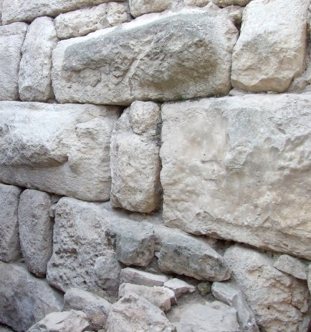 In the case of Nehemiah, we know God wanted to have the walls of Jerusalem rebuilt. This was not an easy task nor was it accomplished without facing serious obstacles each step of the way.
These obstacles will be discussed in future chapters as the repeated threats to the rebuilding of the wall is hard to miss. A large part of the Book of Nehemiah is taken up observing how Nehemiah coped with these forms of opposition.
Before we focus on these troubles, however, we must discover the beauty of hope and how it can touch desperate situations like this and turn it around. Here was a group of people not very unlike post-modern man, living in despair and without purpose or hope in life. Then all of a sudden we see a light flicker in their heart, and they become like those dedicated heroes one reads about in books. Hope can bring about amazing changes.
From the last message we found that Nehemiah was very secretive about his mission. Nehemiah discovered there were some very influential people who did not like what he was up to. They desperately sought ways to frustrate and counter his work.
Nehemiah knew he could not begin right away. Something had to happen before they could start their work. What was that? The people needed hope implanted in their hearts. They needed to know of God’s great purpose.
They needed to come to the point where they believed something good could be done in their lives. Positive changes could be made. Some people want to start programs among the demoralized. We can say with certainty that unless a program has fixed its starting place in creating hope among the people, then it will fail. The same is true with counseling.
Demoralized people are those lacking confidence.
 |
The BFF Bible Training Library has all the Nehemiah studies plus all of BFF's Old Testament Bible resources. Details or purchase. |
The Longstanding Problem of Rebuilding Jerusalem
- Zerubbabel led the first wave of Jews to return in 536 B.C. (Ezra 1-6)
(Big gap of 57 years - Esther's time)
In Feb 18, 516 B.C. the temple was completed and dedicated. - Ezra led the second in 455 B.C. (Ezra 7-10)
- Nehemiah led the third in 445 B.C. (Neh 1-3)
The question before us is why did it take so long to rebuild the wall and restore Jerusalem?
Because there is no confidence, there is no change of behavior. They remain the same in their desperate situation. This is why the scriptures say “Where there is no vision, the people perish” (KJB; Pr 29:18). They are unrestrained (NASB). They might exist but best resemble a blob where their environment shapes them, not God’s purpose and desires.
Nehemiah’s chief goal early on was to bring hope to the people, not to bark out some authoritative commands telling the people to do this and that. Commands and strategic planning is oftentimes necessary and helps accomplishing tasks as rebuilding of the wall. But before this, we must see hope take hold of the people’s hearts, otherwise one will meet with failure of reaching the task or destroying the people’s morale.
This is where Nehemiah radiates as a leader.
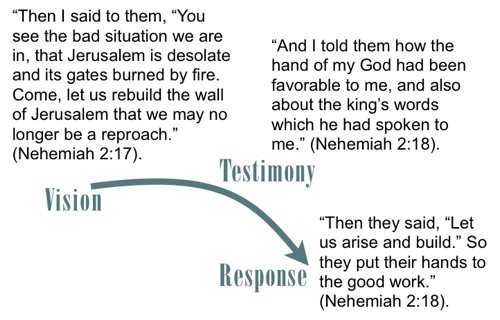
He was not content merely accomplishing the task but strengthening the people. He was there to rebuild the soul of the city. It was Nehemiah’s job to get the job done but this does not mean that he had to ignore the workers. Nehemiah is known as an excellent leader because he motivated the people to work hard and thus accomplished God’s purposes. His vision became theirs.
Understanding burnout
The term ‘burnout’ describes a person convinced of being asked to do more than he can give. Burnout comes when a person finally gives up hope on himself. Two kinds of burnout are described below.
• Expended Burnout
Sometimes burnout occurs after expending a great amount of energy in some inspiring work. Somehow, someway, your hope has been stripped away. Elijah, after the masterful defeat of the Baal worshippers on Mt. Carmel, is a good example of this.
Maybe this burnout derives from not spending sufficient time with the Lord or that one has forgotten His promises. The work goes on. You got to keep it going. The work has to go on. So you continue to devote yourself to that work through pure perseverance and resorting to your own efforts. One day, however, it all comes crashing down. You do not see how the work can go on. You discover your exhaustion.
Conclusion: What God has begun through His Spirit is to be maintained through His Spirit.
• Slave Burnout
Another type of burnout comes about when people do things only because someone has the authority to make them do it. They can do what others are telling them to do, but they do not want to do it. They display their rebellion with tiredness, laziness, criticism, etc. It will not be long before they figure a way of pulling the project to a virtual halt. This kind of burnout is not so radical as giving up on the task, but the same general lack of motivation impedes the progress.
Conclusion: Do not merely focus on completing the task at hand. Include building up the people in one’s plans.
Nehemiah’s approach avoided these things by envisioning the people and working beside them.
Application
If we are honest the jobs we have to do are not the most pleasant or inspiring. This is one reason people are willing to change job scenes even though it creates a risk in the security of their lives. People expect a job to give meaning to life. Meaning in life, however, should find itself in the way we live out our lives in service, whether it be through a paying job or in a volunteer status such as at home.
|
The BFF Bible Training Library has all the Nehemiah studies plus all of BFF's Old Testament Bible resources. Details or purchase. |
Meaning of Life
The modern generation just does not perceive life in a biblical manner. For the most part, they are motivated by money. They become convinced that gaining glamorous high paying jobs is the only means of being highly motivated. Many of you are moving into the work field. Others have been there for awhile. I am not saying that we should not look for stimulating and challenging jobs but that we should not be disappointed if the job does not provide exactly what we are looking for.
Many jobs are repetitively dull; others have managers that make them personally motivating while still others have their own crises: such as financial difficulties, political infighting or even the threat of being bought out or discovering one’s work to be found obsolete.
Meaning of life should not stem from one’s work. If a person’s work brings encouragement, he should thank the Lord. But no matter what, always go back to two principles in your mind:
1) You work because the Lord provides for your needs through your hard work. In this way, you do not steal but have money to give to those in need, and
2) You work unto the Lord.
“Whatever you do, do your work heartily, as for the Lord rather than for men; knowing that from the Lord you will receive the reward of the inheritance. It is the Lord Christ whom you serve” (Colossians 3:23-24).
Yes, you have a boss who watches over your work, but your quality work is done with a cheerful heart not because your boss has been checking up on you, or that your project will be used in the future. You do your best for the Lord. He knows and will take full account of your work. Besides, doing it for Him enables you to grow in your special trusting relationship with Him.
Once hope comes into our lives, many dynamic changes take place. If this hope is based on the truth, then we will be able to trust God for its ongoing value. The Lord will bring about the needed miraculous changes.
Some people try to convince me that I am only a positive or idealistic thinker. I know there is much more to what moves and motivates me. We must firmly place our hopes in God. In the end we are not setting our hopes on our abilities, opportunities or even our capable minds. No. We instead use what we have to accomplish what He sets before us.
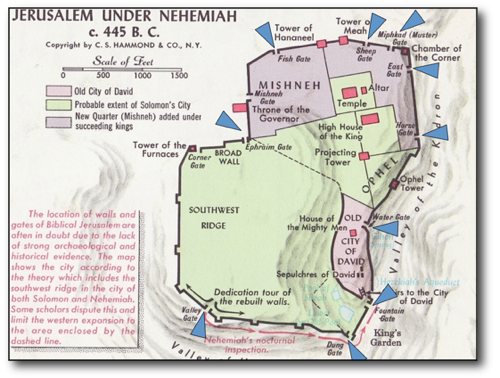
Psalm 118:9 says, “It is better to take refuge in the LORD than to trust in princes.” We will look at the commencement of the rebuilding of the wall. It is impressive. After making observations of their different work, I would like to draw several conclusions leading to different observations on how the truths God make significant help.
Go to expository treatment of Nehemiah 3:1-32 and the specifics on the ten gates.
Book of Nehemiah Index: Rebuilding Your Faith

Nehemiah Overview and Notes | Nehemiah Outline | Also see notes on Ezra
Nehemiah Historical Introduction | Nehemiah Rebuilding the Walls
Nehemiah 1:1-2:5 | Nehemiah 1:1-4 Love for God
Nehemiah 1:11-2.8 God's will | Nehemiah 2.9-20 Prepare
Prayer: Prayers that Changes the World 1:4-11 | Nehemiah 1:1-11 Prayer | Nehemiah 1:05-11 Prayer
Nehemiah 3:1-32 (1/2) Hope | Nehemiah 3:1-32 (2/2) Gates
Nehemiah 3 Jerusalem Map (pdf)
Nehemiah 4:1-6 Anger & Despair | Nehemiah 4:7-23 Anger & Fears
Nehemiah 4:7-23 Threats | Nehemiah 4:7-23 Overcoming Fear
Nehemiah 5:1-05 Loans | Nehemiah 5:1-19 Counts
Nehemiah 6:1-14 Darkness at the Gates
Nehemiah 6:1-19 Rumors | Nehemiah 7:1-73 Restore
Nehemiah 8:1-12 Revival | Nehemiah 8:13-18 Obedience
Nehemiah 9:1-38| Strength & Direction in Life | Confess
Nehemiah 10-12 Covenant | Nehemiah 13:1-31 Restoration
BFF Homepage | Top | About us | Pray for us | BFF's Approach | BFF Store | BFF RSS | Topics | OT | NT
Biblical Foundations for Freedom ( BFF )
Rev. Paul J. Bucknell
Follow @PaulJBucknell
info@foundationsforfreedom.net
Scriptures typically quoted from the New American Standard Bible unless noted:
(C) Copyright The Lockman Foundation 1988