|
Introduction of 1 Corinthians 15
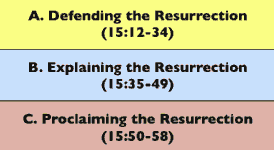
A. Defending the Fact of Resurrection (15:12-34) B. Explaining the Nature of Resurrection (15:35-49 C. Proclaiming the Glory of the Resurrection (15:50-58) Bible Study Questions for 1 Corinthians 12-58 Recently, a sister wanted to know more about spiritual investing. She claimed she was making loads of money. She acknowledged God had gifted her in this way. Most of us hearing this wish they had such a gift. But she had a concern. She knew she had to use it rightly and was looking for a right way to invest it. Why did she do it? Why was she interested in making spiritual investments? Some things are hard to understand. If you do not have an eternal perspective, then many things such as the person above or other things mentioned in the Bible are beyond comprehension. Without a firm confidence in life after death, many things we do will seem ridiculous. Why tithe? Why give to the poor? Why not cheat? Hebrews 11 lists a number of men and women who lived for the future. They were so sure of the importance of what happened after life on earth, that it greatly shaped what they did no earth. These are the men of faith. Though ridiculed by the world, they are highly esteemed by God. They were able to accomplish more with less, gain all with nothing, face dangers, endure hardships and establish great works of God. Our passage today, 1 Corinthians 15, gives us another angle or perspective of the future that enables us to see why living in light of the future is so important. Let me prepare you. Paul’s argument is tight. There is no room for a middle ground. You have to take a stand for or against. What you decide will make a great difference on the well being of your life and those around you. Your life is literally dependent upon it. In essence, nothing about Christianity makes sense if the resurrection is not true. If Jesus did not rise from the dead even Paul says that we are fools. But on the other hand, if Jesus did rise, then everything that He said was and is true. The only thing that counts is the eternal. If this is so, then we had better think again about the purpose for our lives. Where are we making our investments? What do we hope to gain? In the previous verses of 1 Corinthians 15:1-11, we read about the fact or historicity of the resurrection. Most of you realize that there are some people that deny such a thing as the resurrection. • Some claim that the resurrection never occurred. • Others say it did occur, but it doesn’t seem to have affected their lives. Which is worse? The latter group. Perhaps we can better understand this better if we step into the Book of Acts, which records the birth of the Christian church. What would the book of Acts be like if they were not utterly convinced of the resurrection of Christ? Indeed, we would have no book. There would be no Spirit of God. There would be no miracles. My question is, “What happened?” Is the church now so dead that these miracles and boldness is not present? We still have many who proclaim Christ. Then it must be that they don’t really understand or believe that Jesus is alive. As we go through this passage, let’s keep this in mind: What we believe shapes what we do. This is so true when it comes to the teaching of the resurrection. 1) The fact of Christ’s resurrection over the power of death 2) The powerful grace of God at work in a Christian 3) The resurrection hope steers the believer. This is our main discussion. We have an almost unbelievable 46 verses to bring together in one session together today. You might ask, “Why did Paul speak so long on this topic?” We perhaps would think that if he did speak so long that he would speak longer on its historicity. But he closed this argument in a few verses. The argument was closed. Too many people had seen Jesus alive. If they had objections, they could go and talk with them since many were still living! 1 Corinthians will help us gain a wonderful handle on how the resurrection makes a different on my present life.
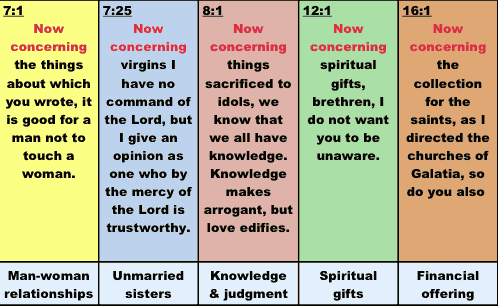
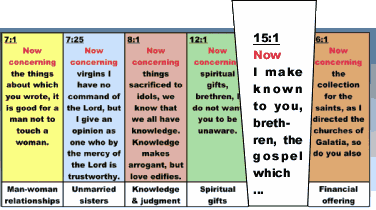
All the way through this second section from chapter 7 right to the end in chapter 16 we see the issues that the Corinthian Christians brought up to the apostle in a letter. Each answer from Paul forms a major part of the letter he wrote to them. Each section is marked off by the exact same words ‘now concerning’ (Greek ‘peri de’). ![]() 1 Corinthians 15 is different. Paul did not similarly start this section with a ‘Now concerning.” There are two possibilities. (1) Chapter 15 a subsection of what preceded it, the section on spiritual gifts and proper worship. (2) Or it could be a separate discussion on a doctrinal controversy the church was then facing. They perhaps did not bring it up but due to its great influence on their lives it needed to be discussed. In either case, Paul discerned he needed to talk extensively about this important aspect of Christian faith and life that they had neglected to ask about. Let me ask you, “Have you ever got tied down so much in the particulars that you lost your focus on the major things of life?” It can happen in your marriage, your personal Christian life or the life of your church as we see here. Let me give you an illustration. Any one who takes pictures knows that he can focus either on the foreground or on the background, the close or the far. He is saying that for us to be a healthy church, we need to focus on the large and glorious things like love and the gospel. Other things will stay in perspective only if we keep focus on these major things. Paul uses the significant word ‘gospel’ twelve times in this letter to the Corinthians.[1] In either case the gospel and the resurrection was not something that they had brought up in their letter but something that they should have. Paul squeezes this long section in and then continues with their questions later on in 16:1. Now let’s go on and see how what one believes about the resurrection is directly related to the vibrancy of their Christian lives. We note three major topics in this passage. 1) Some deny the resurrection of the dead (15:12)
A. Defending the Fact of Resurrection (15:12-34) B. Explaining the Nature of Resurrection (15:35-49 C. Proclaiming the Glory of the Resurrection (15:50-58)
A. Defending the Resurrection (15:12-34)Outline of 15:12-391) Common Sense Argument: If then (12-19) Let’s first look at the verses for this section.
1) Some deny the spirit and emphasize only the body and desires. Only willing to observe what one feels and can see (today’s modernism and materialism, science as its taught).
We have noticed that each extreme causes an overreaction in the other extreme. The greatest problem is that Christians hold to such unsupported philosophies and do not realize it. They think what they believe is Christian without ever analyzing what they believe. Paul was helping them observe their worldview. Paul wants them to see what life would really be like with no resurrection. He 'shocks' them. Those who hold to certain beliefs rarely are consistent in applying what they believe to their lives. If the dead aren't raised, then Christ not raised. Then our preaching is in vain If the dead aren't raised, then Christ is not raised (16) Then your faith is worthless (still in your sins) (17) Without Christ’s resurrection, our Christian faith is empty or void of effectiveness. Do you see how a worldly philosophy or presumption can erode ones faith away? They probably never denied Christ’s resurrection but only wondered about the resurrection of the dead. Paul corners them. Either they fully accept Christ’s resurrection that affirms the resurrection of the body or they deny Christ and His claims. There is no middle road. He pointed out how critical Christian doctrines are founded on the resurrection of Jesus Christ. I believe that many Christians today likewise have a dose of this thinking. They say they believe but down deep they have questions. Some are not honest; others are not aware of them. Unless you have been well trained in apologetics, then more than likely the educational system has neutered your faith. You are a spaded Christian. This is one clear reason that many Christians sit untouched. They don’t know the power of the resurrection. Paul had no problem pointing how crucial the bodily resurrection is to their Christian faith. Why? He saw Christ! He was transformed. The resurrection defends the importance of the body by the fact of its return appearance. We cannot dismiss the value of the body because of death. Something else is coming. Christ proved this by His resurrection.
The Order (15:20-34)The argument is simple. With the knowledge of the scriptures, we know the origin of death. Adam sinned and therefore all his descendants got this malignant spiritual disease called death. We see how one person affected the man. This happened in another way too except we don’t have the final result yet. Jesus Christ came and died for His people’s sins. He came alive. Many witnessed how He was resurrected. The part that we are still waiting for are for those who are connected to Christ through faith to be raised with a glorious body. Of course this hasn’t happened yet. We haven’t first died! • Christ is the first fruits • Christians will follow Christ
Paul presents three time patterns. They are all the same in that one precedes the other. We are to learn from what has occurred so that we will better understand what will happen. History is repetitive, not perfectly in detail but in pattern. 1) Order of Allegiance: Death > Life (15:22)
2) Order of Time: Christ first raised then the Christians (15:23)
3) Order of Purpose: Death reigns > Christ reigns (15:24-28)
Christ subdues all things shown by subduing death (Death conquered all before Him) But then (28) all things including the Son Himself will be subjected to the One who subjected all things to Him.
The modern-day university is forced to deny the resurrection of Christ. After all if Christ is alive, then they are accountable to Him. This becomes a very uncomfortable position. Because of this, Paul then plunges in to some arguments that prove the resurrection. He argues a bit differently than we are used to, but it is thoroughly logical and consistent. Because of the Hope (15:29-33)Baptism for the Dead
Some people get thrown off by 15:29 and make a whole set of doctrines from it. The verse is one of the most vague verses we have in the scriptures. 'Baptism for the dead’ is nowhere else mentioned in the scriptures. Baptism is always for the living. Perhaps Paul is referring to the baptism of a recent professing Christian who did not have the opportunity to be baptized due to some extreme form of persecution, which brought about his death. Or perhaps it refers to some odd ceremony by some in Corinth, maybe not even Christians. In the later case, Paul would not be supporting it but just showing that all our actions of such nature point to the hope of the resurrection. We sometimes refer to the Egyptians hope for the future by pointing to the Pharaoh's elaborate preparations for the life hereafter in the pyramids.
Watch your friend’s beliefs! 15:33-34
In verses 33-34 Paul simply tells them that they have picked up these false doctrines from those around them. They need to avoid such people. “Bad company corrupts good morals.” Every doctrine or teaching has its impact in people’s lives. If we do not live in the power of the resurrection, then we will live for the desires of the flesh. They are to be sober-minded and stop sinning. There are people around us that do not know God and therefore do not accept what God has said about certain things including the resurrection of the body. Belief in the physical resurrection of the body is a crucial doctrine. We should not take a person’s view on this doctrine lightly. If we were to leave this area and find another church elsewhere, this is one teaching that is most important because it affects our whole approach to life.
Think of the early church. Having seen Jesus’ resurrected body, they were challenged by His words. They totally lost their hold on the things of the world. They knew Jesus’ wishes were everything with them. This is why in the beginning of the sermon we spoke on the life of the church is greatly centered on our belief in the resurrection. If Jesus would reveal Himself to us today, would it make a difference on how you respond to Him? He is here. He is anticipating our use of our faith that we could respond to Him even though we do not see Him. Peter says,
B. Explaining the Resurrection (15:35-49)
1) Death and Life (35-39)
2) All things new (40-44)
3) Two Stages (45-49)
We have already followed Paul’s answer to those who ask about whether there is such a thing as the resurrection of the body. Paul has shown that it is clear in nature, in theology and in practice that the resurrection is true. In a practical way, can you see how Christ has changed your life, then believe and put your doubts away. He is alive! There was one other question, however. Others might ask, what is the resurrection like?
The way Paul answers seems to indicate that maybe they were just arguing with Paul over whether it really happens. Paul in 15:35 says, “You fool.” It seems that because their lack of faith in its possibility they ask this question. Paul comes right back with another look at nature.
It seems quite clear that Paul believes God has revealed His truths by what lies around us. Nature is God’s lesson book. We need only to open it up and see. This is true of the resurrection itself. Let’s see if we can clearly present his argument.
So I started exploring how the flour was made. I never realized that whole-wheat flour was simply ground up wheat seed. White flour is the same but stripped of the entire inner portion, which contained important elements and needed fibers. Anyway, planted wheat seed in one section and was excited to see the tall stalks with all their seeds gloriously around each stalk arm. So many seeds are from one stalk. But a greater lesson lay ahead. Every plant must die. Every autumn, each cell of the wheat plant signals the plants of its own impending death. New life depends on the replanting of those seeds. The seeds become places where life again begins. The seeds must first be separated from life, die and be lifeless before it can become of any use. It just exists. If I was to start a new plant, I must tear the living plant out and then plant the seeds. Or perhaps I could just let the seeds drop and hope they by themselves to reproduce. We call this nature but really it is God’s wonderfully designed creation. Jesus taught in parables all the time. He used life illustrations to teach unclear truths. When you eat bread, you are essentially eating ground up kernels of grain or seeds. But you could also take those seeds and with warmth and water, a miracle takes place: life itself. A whole new plant comes alive.
Now Paul emphasizes here that the seed is not like the plant. If you were an expert artist or designer, and you were given a seed, how good of a drawing could you make of what it would become? It is impossible. Every seed is different. Every plant or body of life has its own design. “All flesh is not the same flesh.” People are different from beasts, which again are different from fish. He extends this living principle into inanimate creation. The same is true with the resurrection. This body must die. It is sown but must die. Upon dying it has a seed (a soul), which will be brought up in God’s new world.
We know there is a difference between mankind and the sun. Bears are different from the moon. The sun is different from the moon while the stars differ in their own glory. Each star has its name, character, purpose and design. We understand much more about the stars today. They are a mystery, but we do know like plants, they are different. We are trying to know more with the Mars Rover and Hubble telescope. By studying them, we acknowledge they are different. Stars are very different from what we know or experience on earth. Paul’s argument goes like this. By observing these bodies, whether earthly or heavenly, there will be great changes. We cannot comprehend them just as we cannot understand the glorious stars. Right now when we look at them, we don’t see them, as they will be.
Note how he uses the seed illustration: sown and raised. Sow a seed and up comes its new self.
Conclusion: Our bodies will experience the same change (15:49) The progression, the first and the last, is clearly set forward by Paul. Why is he so elaborate? It is simply to show us the nature of the resurrected body. In summary, then, we simply do not know what the spiritual will be like. It is more glorious than what we have. Does the use of the word spiritual refer to the absence of body? Certainly not. For each has a body. Even the heavenly bodies such as the star have form. It will be different but it will still be your or me. Perhaps what is so important is that we make sure we have the spiritual seed within us. In order to receive this spiritual seed, we need to be born from above. This is where we receive the beginnings of our new nature though it will not have its fullest appearance until we are resurrected. This is what he now goes on and discusses. Everything will be so new and exciting. C. Proclaiming the Resurrection (15:50-58)Paul takes this chance to clearly put forward what happens during the resurrection. #1 First of all, we need to put this earthly body aside. It is made from earth’s elements. Adam literally means red like the dust of the earth. The atoms are marvelous assembled - truly no accident, but it is not good enough for God’s eternal plans. It is impossible for any of us, even Jesus, to take this flesh and blood into heaven. Heaven is of a different sort of place.
#2 Secondly, we need to realize that this need for transformation should not present any alarms for those who are still alive on the day of Christ’s return. Some will not sleep. That means some Christians will not die. They will be alive when Christ returns. These individuals will not miss the kingdom of heaven. There is a special exception for them. This does not mean their bodies go to heaven but they will be changed in split-second process.
#3 Thirdly, the resurrection takes place at the last trumpet. At the sound of that trumpet, the dead will be raised. They will receive an imperishable body. That is a wonderful solution for our Medicare and retirement fund crisis! The imperishable will be immortal.
#4 Fourthly, death will be conquered. The resurrection of God’s people steals all of God’s people from death’s grasp. The risen life will taunt death with its very life. We have been set free from death. Of course, this happened because sin, which caused death, was effectively dealt with through the cross.
#5 Lastly, we need to be greatly affected by the fact of the coming resurrection. Paul says it so clearly in 15:58.
We are called to three responses.a) Be steadfast. We are to be constant in our walk with God. Never veer from His way. b) Be immovable. We are to stay focused. We are not to have anything, even crises, emotional ups and downs, temptations, persecution, etc. to disturb what we are about. We are living for the next age. We can let things go as needed. c) We are to abound in the work of the Lord. This is the key. Paul is hardly talking to pastors or even just the leaders here. He is referring to all Christians everywhere. All are to do abundant works through the Lord. This is the resurrection power that affects us now. We are so convinced of the value of storing up good works, we value that more than ten times the storing up of money or wealth on earth. The resurrection is coming. Our activities, even as hard as they might be, are not in vain. They are very effective. I tell my children where we invest our money. It is not in things but in giving to the poor or helping out some missionary. What about you? Are you steadfast, immovable and abounding in God’s work? We only have a little time left. Of course we don’t know if the Lord will return today. He might. Or we might need to die first. The point is when our heart is there, and then this is no longer home. We want to be elsewhere because our heart is already there.
1) What are the two major parts of the 1 Corinthian letter? What makes each section different?
|
|||||||||||||||||||||||||||||