|
|
|
Matthew divided his gospel into five parallel sections each consisting of a narrative (story telling) and a teaching section. The fivefold repetition of "when Jesus had finished" {7:28; 11:1; 13:53; 19:1; 26:1) concludes each major section which consists both of a narrative and a discourse. |
Are you trying to figure your best way of maneuvering yourself or getting something? Or are you like Jesus who saw and responded to the needs of the crowds?
When Jesus saw the crowds,
He went up the hillside...
and began to teach. (Mat 5;1-2)
Jesus did not entertain the crowd but ministered to them. He was not content on impressing them. In chapter 4 we already find that Jesus gained fame all about Galilee, Syria, Decapolis, Jerusalem, Judea and even across the Jordan River.
Entertainers draw attention to themselves. Christ rejected this worldly attention and instead focused on bringing the power of Gods kingdom to the lives of God's people.
The key to Christian living is not watching or even repeating Jesus but being like Him. Simply sitting besides these disciples and being astonished at His teaching would be completely worthless. We would not experience the power of Christ's kingdom. Christ's purpose was to convey what we needed to live as active participants in His kingdom. The question is, "How did He do this?"
Matthew purposely stopped relating the dynamic power of Christ at the end of chapter 4 and retold us the Sermon on the Mount. Discipleship is not a one stage stop but many acts of discipline where we purposely and intentionally make decisions to live righteous lives after Christ.
There are no proper shortcuts to know the power of God's kingdom. Jesus refused to fall to the temptation to take the easy road (cf. Mat 4:8). He purposely focused His life on serving His Father and His people.
|
![]() |

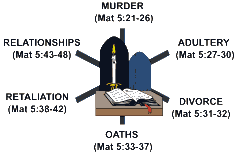
(a) Murder - Anger (5:21-26)
(b) Adultery - Lust (5:27-30)
(c) Divorce - Covenant breaker (5:31-32)
(d) Oaths - Lack of Integrity (5:33-37)
(e) Retaliation - Bitterness (5:38-42)
(f) Relationships - Self-focused (5:43-48)
Alms (1-4) Prayer (5-15) Fasting (16-18)
B. Detecting divided hearts (6:19-34)Treasures (19-23) Worries (24-34)
Judgmental (1-5) Gracious (6-12)
Decisions (13-14) Tests (15-23) Foundations (24-29)
Jesus first teaches us the eight principles of the Kingdom of God better known as the Beatitudes. Each principle is a key to living a godly life. Each brings a blessing from God. They are focused positively on what we should be like rather than on what we should not do. Although they are in perfect agreement with the Ten Commandments, they are different. They do not merely keep us from evil but lead us to truth. Because of the power of the Holy Spirit in our lives, the people of God can have the love and holiness of God dominate their lives.
How well do you know these 8 beatitudes? Can you explain them?
What hard decisions have you made in your life to live faithfully by them?
People will wonder whether the principles that Jesus just declared were of God. After all, Jesus does not quote the scripture or attribute His words to some famous teacher. We can almost hear the scribes and Pharisees decrying Jesus' principles and asserting their own Biblical teaching in Matthew 5:17.
"Do not think that I came to abolish the Law or the Prophets; I did not come to abolish, but to fulfill."
Jesus continues in this second section to clarify His position with the Word of God, known then by the phrase the 'Law and Prophets.' Jesus first declared His clear affirmation to heed and indeed fulfill the Word of God. He then carefully describes six times the Jewish teachers had not carried out God's Law. Jesus not only showed how they misconstrued the teachings of scriptures but also clarified what the proper biblical perspective was. Note the repeated, "You have heard..." and "But I say to you..." phrases. Jesus lifts Himself up to being of equal authority with the holy Word of God.
How well do you know the scriptures? What about the Old Testament?
Can one really know the truth? Do you think Jesus thought it important? How do we know?
Are you able to take all that you know and do and test it upon the scriptures?
The Jewish leaders failed, how do you think you might do?
This last section of the Sermon Jesus uncovers four wrong attitudes toward life. He reveals the emptiness of spiritual disciplines and scriptural admonition when ones heart is not right. Wrong attitudes always happen when our hearts are not submissive to God. They will invariably twist biblical instruction to satisfy their own selfish desires. These selfish attitudes always affect ones life style.
These pretences of true religion are devious because it is so easy to imitate them. Jesus uncovers these false life styles so that His own disciples will be shielded from them. We are God's servants only when the truth of God shakes our very attitudes toward life. It is then that God's love shapes our perspectives of others rather than our lofty view of ourselves. Jesus in this last section
What are your true motives were for different 'spiritual' activities like worship?
Name one time you caught imitating some Christian rather than doing it from your heart?
How can we pass on this 'heart' Christianity rather than this 'hypocritical' and hollow religion?
| Matthew 1:22-23 | Bridge of Life; Immanuel |
| Matthew 5-7 | Sermon on Mount: Introduction, Outline, Bible Study |
| Matthew 5:1-12 | The Eight Beatitudes |
| Matthew 5:21-48 | Sermon on Mount: Six Test Cases of Love |
| Matthew 5:33-37 | Sermon on Mount: Walking in Integrity |
| Matthew 6:21 | Sermon on Mount: Detecting Heart Divisions |
| Matthew 11:28-30 | Finding Rest for Your Weary Souls |
| Matthew 12:7 | 'I Desire Compassion' |
| Matthew 15:21-28 | Staying Focused on God's Will |
| Matthew 17:24-27 | Trusting God for money |
| Matthew 18:21-22 | Forgive with Liberality |