Stages of Discipleship and Spiritual Growth
Explore the stages of Christian spiritual growth and learn how disciples progress from new faith toward maturity through truth, obedience, and practice.
Understanding Christian Spiritual Growth
Paul J. Bucknell
_________________________
Discipleship and Spiritual Growth?
The greatest fault of the Christian church, perhaps, is the assumption that spiritual growth will just happen. We must fight the 'independent' attitude today, which lets everyone learn on their own. Christ said we need to make disciples. As a church, we need to think through where we want our people to be in areas of giving, discipling, evangelizing, family care, loving of neighbors, etc. We can no longer assume people know what to do.
I know that if someone had taken me aside when I was a young Christian and guided me in what I should do, how I should live, and how to study the Bible, it would have made a tremendous difference in my Christian life. I blundered about. Fortunately, God slowly weaned me through this process.
On the other hand, you might have a great concern as a leader in the church for others. For example, you, as a deacon, might have a great concern about taking further steps in protecting the people against the sexually immoral teachings or materialism infecting the church. Most of the time, we say a prayer and mention the need at a meeting. It is discussed, and then a general comment is made: "It is too bad." You pray some more and quickly forget about the need.
As leaders, we should be proactive in training our people in the areas that they need. With a group, consider where the Christians are now and where they need to go. The following questions will help you think through this process.
You then need to go to your leaders in prayer with a thought–out plan. It is easy to tell people what not to do, but we need to focus on where we need to bring the people of God. By His grace, we can do this.
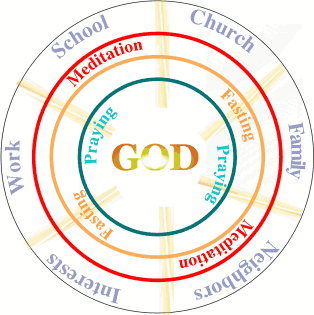
Christ is center of our lives
Because God is at the center of our lives, He is to influence each aspect of our lives.
Spiritual disciplines such as meditating on the Word, praying, attending church, fellowshipping with Christians, and fasting help feed us God's Word so that God will thoroughly impact every area of our lives. Without these spiritual disciplines and being discipled by another, these changes would be near impossible.
We are responsible for examining each area of our lives and assessing which needs to be changed and brought into conformity to Christ.
How far has Godinfluenced each
aspect of your life?
 "This book of the law shall not depart from your mouth, but you shall meditate on it day and night, so that you may be careful to do according to all that is written in it; for then you will make your way prosperous, and then
you will have success."
Joshua 1:8
Key questions to ask in discipling another person
We want to think through these stages of Christian spiritual growth with you so that you, as a parent, discipler, pastor, or friend, can take an active part in God's great discipling program throughout the world!
Here are some questions to begin to get you thinking:
-
What areas of growth are we hoping the disciple grow in?
-
Rate the person's willingness to grow in those areas of need. What has shown you this person’s interest?
-
How have you grown in these areas? What has God taught you? How has He taught you?
-
Where is that person right now in those areas of his or her life?
-
By God's almighty power and grace, where should that person ideally be in those areas? Where should you be?
-
What steps are needed to bring that person to those goals?
-
Under this last crucial step, we might approach it from a different perspective, such as:
- Truths a person needs to learn
- Activities needed for fostering growth
- Areas in which we are praying for discernment
Five Misconceptions of Discipleship
-
Discipleship takes place when people attend church programs.
A life-changing series that causes us to renew our hope that God wants to specially meet every one of His children each day.
In fact, much good teaching can take place during church, but it is often too general and not targeted to the special needs of a new Christian.
- Discipleship just happens.
In fact, we must go countercultural and instruct others personally and lovingly about the ways of Christ. We need to ask the hard questions and get involved in the process of why they do things.
- Discipleship is only for new Christians.
In fact, discipleship is a process that should be occurring all through our lives. A disciple always follows his master's life. Once a disciple, always a disciple.
- Discipleship is a program.
In fact, discipleship is a lifestyle. We are Christ's disciples and this Christian life calls us to learn and live like Him. This will require significant changes in the way we think and live.
- Discipleship is only for certain parts of our lives.
In fact, Christ wants to teach us in each aspect of our lives from our parenting skills to handling finances. This differs from some cults, which will actually make your decisions for you! Mentoring is the training of a person in one or more specific areas.
True discipleship must take all of Christ's teaching and implement them into our lives in such a way that we live like Christ did. We must not be content with merely passing on knowledge and tradition and assume that conviction and belief simply arise. Instead, we are to live out the life before those we instruct, just as Christ did. There is a great difference between the modern student and a disciple.
A Biblical Model of the Discipleship Process
Even more important is understanding the whole process of discipleship in a church (or individual). Why does Jesus leave us essentially one command, 'to make disciples?' Once this whole scheme of things is understood, then we can begin to examine each set of materials or the existing programs that our church might now use. We have written quite extensively on this in 'The Flow.'
Click the Library image to see all the BFF discipleship materials that are now available !